Mumbai’s skyline is changing fast, and so is the ground beneath it. From rooftop gardens in Powai to FIFA-standard football pitches in Thane, the demand for durable, sustainable, and visually stunning turf has never been higher. If you have ever wondered why some sports fields hold up through the monsoon while others turn into mud pits by August, the answer lies in construction quality, not just the grass itself.
Best Turf Construction in Mumbai is no longer a niche service – it’s a fast-growing category shaped by water scarcity, sports infrastructure booms, and India’s push toward smarter urban design. In this guide, we break down exactly what separates a premium turf installation from a mediocre one, and why getting it right the first time saves lakhs of rupees in the long run. For readers exploring options, turf construction in Mumbai by Turf8 offers a useful benchmark for what a professionally engineered turf system should look like from base to blade.
Why is professional turf construction important in India in 2026?
Best Turf Construction in Mumbai starts with understanding why the foundation matters more than the grass on top. A poorly built base leads to drainage failure, uneven surfaces, and turf that degrades within 18–24 months instead of lasting 8–10 years.
India’s artificial turf market reached roughly 351.5 million in 2025, with sports complexes, landscaping, and residential applications driving demand</cite>. Much of this growth is fuelled by urbanisation and the search for water-efficient, low-maintenance green surfaces in cities like Mumbai, Pune, and Nagpur.
Best Turf Construction in Mumbai projects also benefit from national policy tailwinds. Sports-focused artificial turf remains the dominant segment in India, driven largely by the government’s Khelo India initiative, which has spurred the construction of FIFA-certified football pitches and FIH-approved hockey fields across regional cities. With the Union Budget 2026–27 raising the Ministry of Youth Affairs and Sports allocation ₹4,479.88 crore, an increase of over 18% from the previous year, schools, municipal corporations, and private academies across Maharashtra are investing heavily in professional-grade playing surfaces.
- Poor base preparation is the #1 cause of turf failure in Mumbai’s monsoon climate
- Compaction and drainage engineering determine turf lifespan more than fibre quality alone
- Government-backed sports infrastructure spending is accelerating demand for certified installers
What makes a sports turf “quality” – and how is it different from ordinary landscaping turf?
Best Turf Construction in Mumbai for sports applications is a fundamentally different discipline than decorative landscaping turf. Sports turf must meet performance standards for ball roll, shock absorption, and player safety, while landscape turf prioritises aesthetics and low upkeep.
A genuinely high-quality sports turf system includes several engineered layers:
- Sub-base compaction – a stable, well-graded aggregate layer that prevents settling
- Drainage system – perforated pipes and permeable layers designed for Mumbai’s heavy monsoon rainfall (often 2,000+ mm annually)
- Shock pad or cushioning layer – reduces injury risk on football, hockey, and multi-sport fields
- UV-stabilised synthetic fibres – polyethylene yarns that resist fading and matting under intense sun
- Infill material – silica sand, rubber granules, or organic infill that supports blade structure and ball bounce
At Turf8, we specialize in engineering each of these layers to Indian climatic conditions rather than importing a one-size-fits-all specification designed for cooler, drier markets.
How much does turf construction cost in Mumbai in 2026?
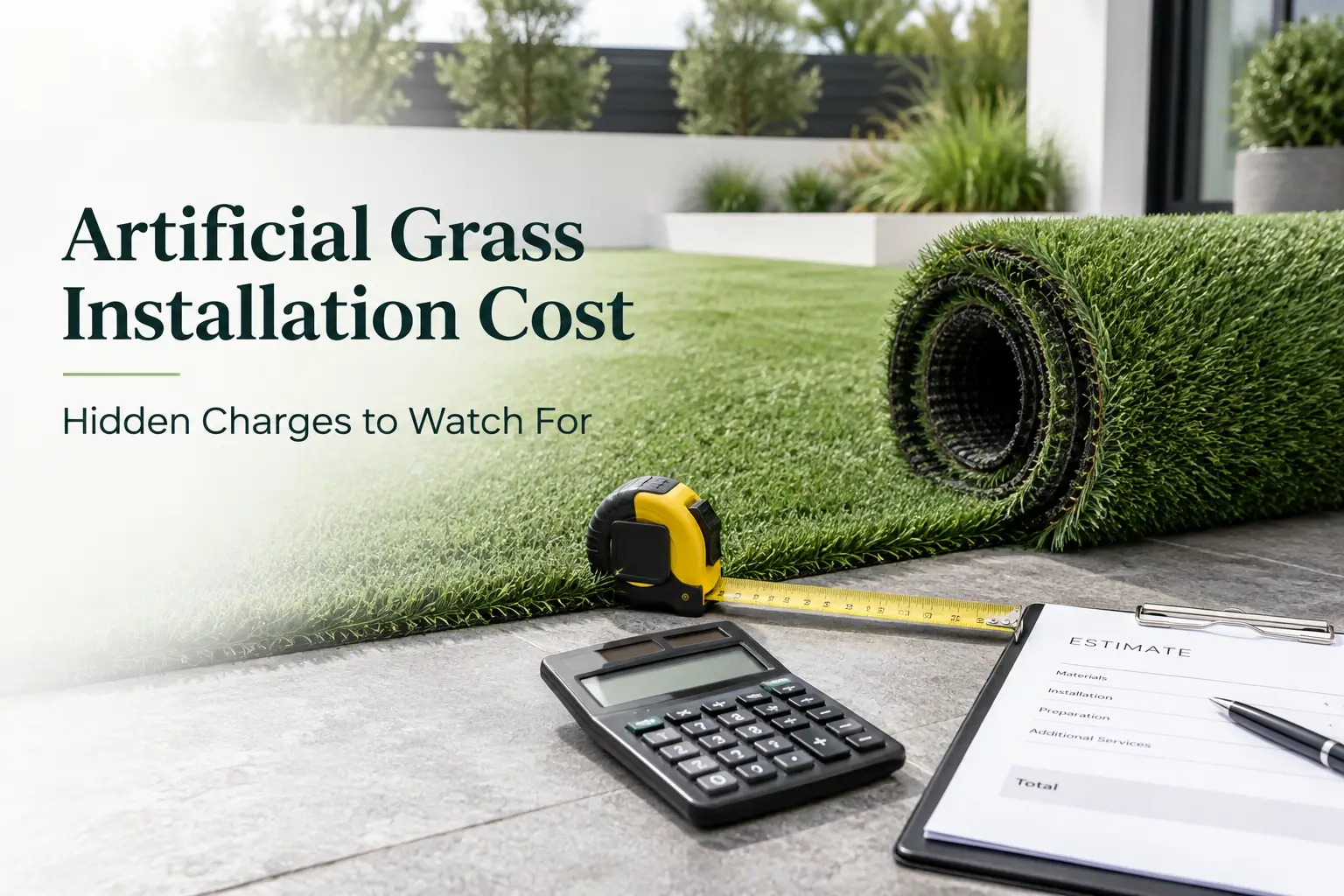
Best Turf Construction in Mumbai pricing varies significantly based on application, turf grade, and site preparation needs. Here are realistic 2026 market estimates:
| Application | Estimated Cost (₹ per sq. ft.) |
| Residential landscaping turf (basic) | ₹65 – ₹110 |
| Residential landscaping turf (premium) | ₹120 – ₹180 |
| Terrace/rooftop turf with drainage layer | ₹140 – ₹220 |
| Commercial/office landscaping | ₹100 – ₹160 |
| School multi-purpose sports turf | ₹250 – ₹400 |
| FIFA/FIH-grade football or hockey turf | ₹450 – ₹750 |
| Cricket practice pitch (matting + turf) | ₹300 – ₹550 |
Annual maintenance plans in Mumbai typically range from ₹8,000 to ₹25,000 for residential lawns and ₹1.5 lakh to ₹6 lakh for full-sized sports fields, depending on foot traffic, brushing frequency, and infill top-up requirements. According to Turf8’s 2026 India market insights, government and institutional projects often bundle a 3–5-year maintenance contract into the initial installation cost, which reduces total lifecycle spend by 15–20% compared to ad-hoc servicing.
How does Turf8 ensure premium quality turf installation?
Best Turf Construction in Mumbai requires a contractor who understands both engineering and India’s climatic extremes – intense pre-monsoon heat, prolonged humidity, and torrential rainfall within the same calendar year.
Turf8’s advanced turf technology ensures every project undergoes soil testing, drainage modelling, and load-bearing assessment before a single blade of turf is laid. Our process typically includes:
- Site survey and soil analysis to determine drainage gradient and compaction needs
- Custom sub-base design using crushed stone aggregate rated for local rainfall intensity
- Geotextile and shock pad layering for sports and high-footfall commercial areas
- Precision seaming and stitching to eliminate visible joints and reduce wear points
- Infill calibration matched to the specific sport or landscaping use case
- Post-installation quality checks, including ball-bounce and permeability testing for sports fields
This layered approach is why Turf8 is trusted across residential complexes, commercial properties, sports academies, schools, and government-backed projects in Mumbai, Navi Mumbai, Thane, and increasingly in Tier 2 and Tier 3 cities such as Nashik, Nagpur, and Aurangabad.
Is artificial turf better than natural grass for Mumbai’s climate?
Best Turf Construction in Mumbai often comes down to choosing between natural and artificial turf, and the answer depends heavily on usage intensity and budget.
Natural grass remains preferred for premium golf courses and certain heritage sports clubs, but it demands constant irrigation, mowing, and pest control – costly in a city where water is a scarce municipal resource. <cite index=”1-1″>Rising concerns about water conservation and the high maintenance cost of natural grass, especially in high-temperature regions, are driving demand for artificial turf globally, and Mumbai’s dense urban footprint makes this trend even more pronounced.
Artificial turf, by contrast, requires no watering, survives heavy foot traffic, and stays playable within hours of a downpour rather than days. As of 2026, the pivot toward synthetic sports infrastructure is driven by the need for all-weather playability and significantly lower water consumption compared to natural grass</cite>, making it the practical choice for schools, academies, and residential complexes with limited groundskeeping staff.
Quick comparison:
- Water usage: Artificial turf uses close to zero; natural grass can require thousands of litres monthly
- Playability after rain: Artificial turf is usable within hours; natural grass may need days to dry
- Maintenance cost: Natural grass costs significantly more annually in labour, water, and fertiliser
- Lifespan: Quality artificial turf lasts 8–10 years with proper care; natural grass needs continuous renewal
What sustainable practices should turf construction follow in 2026?
Best Turf Construction in Mumbai increasingly means sustainable turf construction, as environmental compliance becomes a bigger part of urban development approvals.
Modern Indian turf manufacturing has shifted toward recycled and eco-labelled materials. Industry data shows a growing share of manufacturers <cite index=”6-1″>incorporating shock pads for cushioning, applying anti-microbial coatings, and using sustainable materials such as recycled plastics to reduce environmental footprint. Non-infill and low-infill turf systems are also gaining traction among institutional buyers who want to minimise microplastic runoff – a concern regulators are watching closely as adoption scales up.
- Water-permeable backing systems that support monsoon drainage and reduce urban flooding risk
- Recycled polyethylene and polypropylene yarns that lower the carbon footprint of production
- Non-infill or organic infill systems that reduce microplastic dispersal into stormwater drains
- End-of-life recycling programs for turf replacement, reducing landfill burden
At Turf8, we specialize in sourcing infill and backing materials aligned with these sustainability benchmarks, helping housing societies and institutions meet green building expectations without compromising performance.
Which sectors in Mumbai and beyond are driving turf demand?
Best Turf Construction in Mumbai is being shaped by demand across multiple sectors, not just sports.
- Residential complexes – podium gardens, terrace lawns, and clubhouse landscaping in high-rise developments across Mumbai and Navi Mumbai
- Commercial properties – office campuses, IT parks, and hospitality projects using turf for low-maintenance green cover
- Sports academies and stadiums – football, cricket, and hockey facilities upgrading to synthetic surfaces backed by Khelo India funding
- Schools and educational institutions – multi-purpose playgrounds replacing dust courts with all-weather turf
- Government and municipal projects – public parks and community sports grounds in Tier 2/Tier 3 cities
India’s artificial turf sector is projected to be among the <cite index=”1-1″>fastest-growing markets in the Asia Pacific region, at roughly 8.0% CAGR, supported by government backing for sports infrastructure and expanding football, cricket, and hockey training centers. This growth is visible well beyond metro cities – Turf8’s project pipeline now spans housing societies in Pune, school grounds in Nashik, and community sports complexes in smaller Maharashtra towns, reflecting how turf construction demand is decentralizing from Mumbai alone into Tier 2 and Tier 3 markets.
How long does professional turf installation take?
Best Turf Construction in Mumbai timelines depend on project size and site conditions, but most installations follow a predictable schedule:
- Residential lawns (under 1,000 sq. ft.): 2–4 days including base preparation
- Terrace or rooftop turf: 3–5 days, factoring in waterproofing checks
- School or academy multi-sport courts: 10–20 days depending on drainage complexity
- Full-sized football or hockey turf fields: 30–45 days including certification testing
Weather planning matters too – most contractors, including Turf8, schedule large outdoor installations before the monsoon onset (typically completing Mumbai projects between November and April) to avoid waterlogged site conditions that can compromise base compaction.
People Also Ask: Quick Answers
Q: What is the average lifespan of artificial turf in Mumbai’s climate?
A: With proper installation and maintenance, quality artificial turf lasts 8–10 years, even under Mumbai’s heavy monsoon and high humidity conditions.
Q: Is artificial turf safe for children and pets?
A: Yes, when installed with a proper shock pad and non-toxic, UV-stabilised polyethylene fibres, artificial turf is safe for children’s play areas and pet-friendly outdoor spaces.
Q: Does artificial turf get too hot in Mumbai’s summer?
A: Turf can heat up under direct afternoon sun, but light-coloured infill, proper ventilation gaps, and occasional water misting significantly reduce surface temperature.
Q: Can artificial turf be installed on a waterproofed terrace?
A: Yes, provided a drainage mat and root-barrier layer are added beneath the turf to protect the waterproofing membrane and allow proper runoff.
Q: How often does artificial turf need maintenance?
A: Residential turf typically needs brushing and debris removal every 2–4 weeks, while high-traffic sports turf requires professional grooming and infill top-up every 1–2 months.
Frequently Asked Questions
Q1. What is the cost of installing artificial turf for a home lawn in Mumbai?
A: Residential turf installation in Mumbai typically ranges from ₹65 to ₹180 per square foot in 2026, depending on turf grade, pile height, and site preparation requirements.
Q2. How is Turf8 different from other turf contractors in Mumbai?
A: Turf8 combines soil engineering, drainage design, and certified sports-grade materials into every project, backed by structured maintenance plans for residential, commercial, and institutional clients across Maharashtra.
Q3. Can Turf8 handle government and school sports turf projects?
A: Yes, Turf8 has experience delivering turf construction for schools, academies, and government-backed sports infrastructure projects, aligned with Khelo India-linked facility standards.
Q4. Is natural grass or artificial turf more cost-effective long term?
A: Artificial turf generally proves more cost-effective over a 5–10 year period due to zero irrigation needs, minimal labour, and far lower recurring maintenance costs compared to natural grass.
Q5. Does turf construction require special monsoon-proofing in Mumbai?
A: Yes, a properly engineered drainage layer and permeable backing are essential in Mumbai to prevent waterlogging and turf degradation during the monsoon season.
Q6. How do I get a turf construction quote for my property?
A: You can request a site assessment and customised quote directly through Turf8’s project team, who evaluate square footage, application type, and drainage needs before providing final pricing.
Choosing the right partner for turf construction isn’t just about the grass you see – it’s about the engineering you don’t. Whether you’re upgrading a housing society’s clubhouse lawn, building a school playground, or constructing a certified sports field, the difference between turf that lasts a decade and turf that fails in two monsoons comes down to who builds the foundation. As India’s sports and landscaping infrastructure continues to expand through 2026 and beyond, working with an experienced, data-driven partner like Turf8 ensures your investment performs – season after season.