
Best Turf Construction in Mumbai: What Makes a Quality Sports Turf?
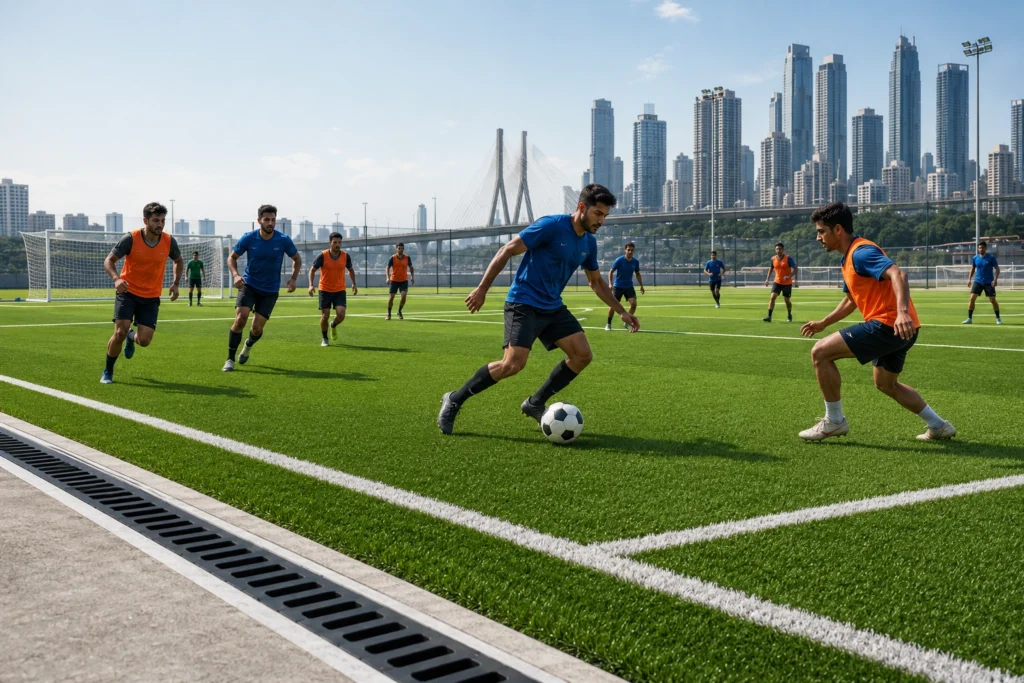
Mumbai’s skyline is changing fast, and so is the ground beneath it. From rooftop gardens in Powai to FIFA-standard football pitches in Thane, the demand for durable, sustainable, and visually stunning turf has never been higher. If you have ever wondered why some sports fields hold up through the monsoon while others turn into mud pits by August, the answer lies in construction quality, not just the grass itself. Best Turf Construction in Mumbai is no longer a niche service – it’s a fast-growing category shaped by water scarcity, sports infrastructure booms, and India’s push toward smarter urban design. In this guide, we break down exactly what separates a premium turf installation from a mediocre one, and why getting it right the first time saves lakhs of rupees in the long run. For readers exploring options, turf construction in Mumbai by Turf8 offers a useful benchmark for what a professionally engineered turf system should look like from base to blade. Why is professional turf construction important in India in 2026? Best Turf Construction in Mumbai starts with understanding why the foundation matters more than the grass on top. A poorly built base leads to drainage failure, uneven surfaces, and turf that degrades within 18–24 months instead of lasting 8–10 years. India’s artificial turf market reached roughly 351.5 million in 2025, with sports complexes, landscaping, and residential applications driving demand</cite>. Much of this growth is fuelled by urbanisation and the search for water-efficient, low-maintenance green surfaces in cities like Mumbai, Pune, and Nagpur. Best Turf Construction in Mumbai projects also benefit from national policy tailwinds. Sports-focused artificial turf remains the dominant segment in India, driven largely by the government’s Khelo India initiative, which has spurred the construction of FIFA-certified football pitches and FIH-approved hockey fields across regional cities. With the Union Budget 2026–27 raising the Ministry of Youth Affairs and Sports allocation ₹4,479.88 crore, an increase of over 18% from the previous year, schools, municipal corporations, and private academies across Maharashtra are investing heavily in professional-grade playing surfaces. What makes a sports turf “quality” – and how is it different from ordinary landscaping turf? Best Turf Construction in Mumbai for sports applications is a fundamentally different discipline than decorative landscaping turf. Sports turf must meet performance standards for ball roll, shock absorption, and player safety, while landscape turf prioritises aesthetics and low upkeep. A genuinely high-quality sports turf system includes several engineered layers: At Turf8, we specialize in engineering each of these layers to Indian climatic conditions rather than importing a one-size-fits-all specification designed for cooler, drier markets. How much does turf construction cost in Mumbai in 2026? Best Turf Construction in Mumbai pricing varies significantly based on application, turf grade, and site preparation needs. Here are realistic 2026 market estimates: Application Estimated Cost (₹ per sq. ft.) Residential landscaping turf (basic) ₹65 – ₹110 Residential landscaping turf (premium) ₹120 – ₹180 Terrace/rooftop turf with drainage layer ₹140 – ₹220 Commercial/office landscaping ₹100 – ₹160 School multi-purpose sports turf ₹250 – ₹400 FIFA/FIH-grade football or hockey turf ₹450 – ₹750 Cricket practice pitch (matting + turf) ₹300 – ₹550 Annual maintenance plans in Mumbai typically range from ₹8,000 to ₹25,000 for residential lawns and ₹1.5 lakh to ₹6 lakh for full-sized sports fields, depending on foot traffic, brushing frequency, and infill top-up requirements. According to Turf8’s 2026 India market insights, government and institutional projects often bundle a 3–5-year maintenance contract into the initial installation cost, which reduces total lifecycle spend by 15–20% compared to ad-hoc servicing. How does Turf8 ensure premium quality turf installation? Best Turf Construction in Mumbai requires a contractor who understands both engineering and India’s climatic extremes – intense pre-monsoon heat, prolonged humidity, and torrential rainfall within the same calendar year. Turf8’s advanced turf technology ensures every project undergoes soil testing, drainage modelling, and load-bearing assessment before a single blade of turf is laid. Our process typically includes: This layered approach is why Turf8 is trusted across residential complexes, commercial properties, sports academies, schools, and government-backed projects in Mumbai, Navi Mumbai, Thane, and increasingly in Tier 2 and Tier 3 cities such as Nashik, Nagpur, and Aurangabad. Is artificial turf better than natural grass for Mumbai’s climate? Best Turf Construction in Mumbai often comes down to choosing between natural and artificial turf, and the answer depends heavily on usage intensity and budget. Natural grass remains preferred for premium golf courses and certain heritage sports clubs, but it demands constant irrigation, mowing, and pest control – costly in a city where water is a scarce municipal resource. <cite index=”1-1″>Rising concerns about water conservation and the high maintenance cost of natural grass, especially in high-temperature regions, are driving demand for artificial turf globally, and Mumbai’s dense urban footprint makes this trend even more pronounced. Artificial turf, by contrast, requires no watering, survives heavy foot traffic, and stays playable within hours of a downpour rather than days. As of 2026, the pivot toward synthetic sports infrastructure is driven by the need for all-weather playability and significantly lower water consumption compared to natural grass</cite>, making it the practical choice for schools, academies, and residential complexes with limited groundskeeping staff. Quick comparison: What sustainable practices should turf construction follow in 2026? Best Turf Construction in Mumbai increasingly means sustainable turf construction, as environmental compliance becomes a bigger part of urban development approvals. Modern Indian turf manufacturing has shifted toward recycled and eco-labelled materials. Industry data shows a growing share of manufacturers <cite index=”6-1″>incorporating shock pads for cushioning, applying anti-microbial coatings, and using sustainable materials such as recycled plastics to reduce environmental footprint. Non-infill and low-infill turf systems are also gaining traction among institutional buyers who want to minimise microplastic runoff – a concern regulators are watching closely as adoption scales up. At Turf8, we specialize in sourcing infill and backing materials aligned with these sustainability benchmarks, helping housing societies and institutions meet green building expectations without compromising performance. Which sectors in Mumbai and beyond are driving turf demand? Best Turf Construction in