India’s sports and landscaping infrastructure is undergoing a profound transformation. With over ₹14,000 crore allocated under the Khelo India programme and Smart City Mission for 2025–2026 alone, the demand for high-performance turf solutions has never been greater. From premium residential complexes in Gurgaon and Bengaluru to football academies in Bhubaneswar and padel courts in Pune, the artificial turf market is growing at a CAGR of 9.3% — making the choice of a trusted partner more critical than ever.
Choosing the right artificial turf manufacturers is not just a procurement decision — it is a long-term investment in safety, performance, and aesthetics. With dozens of vendors flooding the Indian market, separating genuine quality from cheap imitation requires a sharp eye and informed decision-making.
That is exactly why Turf8, India’s leading turf construction company, has put together this essential guide — to help homeowners, facility managers, sports clubs, schools, and government bodies make the right choice in 2026.
1. Why Does FIFA/ITF/AIFF Certification Matter When Selecting Artificial Turf Manufacturers?
Artificial turf manufacturers operating in India’s professional sports segment must hold internationally recognised certifications such as FIFA Quality Pro, ITF (International Tennis Federation), or AIFF-approved standards. These certifications are not formalities — they define ball-roll consistency, shock absorption, surface hardness, and durability under Indian climate conditions.
In 2026, the Bureau of Indian Standards (BIS) has also tightened its norms for synthetic surfaces in government-funded school grounds and municipal sports complexes. Any manufacturer unable to produce valid certification documents should be disqualified at the outset.
2. What Types of Turf Systems Should Reputed Artificial Turf Manufacturers Offer?
Artificial turf manufacturers worth your consideration should offer a full portfolio of turf systems tailored to specific use cases. A one-product vendor cannot adequately serve the diversity of India’s turf applications.
In 2026, the primary categories to evaluate include:
• Sports Turf: FIFA-grade football turf, cricket practice nets, padel court surfaces, tennis court systems, and pickleball courts
• Landscape Turf: Residential lawns, rooftop gardens, commercial interiors, hotel lawns, and urban green zones
• Specialised Systems: Child-safe playground turf, pet-friendly low-infill turf, and heat-resistant varieties for Maharashtra, Rajasthan, and Tamil Nadu summers
At Turf8, we specialise in over 12 product categories — from FIFA-certified football surfaces to premium landscape solutions — ensuring clients receive the most suitable system for their project, not just the most available one.
3. How Do You Evaluate the Raw Material Quality of Artificial Turf Manufacturers?
Artificial turf manufacturers that compromise on raw materials will invariably deliver surfaces that fade, shed, or deform within two to three years — especially in India’s harsh UV and monsoon conditions.
When evaluating material quality, focus on these key parameters:
• Yarn Type: Monofilament PE (polyethylene) is superior to slit-film or fibrillated yarns for sports use. Look for UV-stabilised, lead-free yarn with a minimum 8-year colour-fade warranty.
• Backing System: Double-layer woven PP backing with polyurethane coating offers maximum dimensional stability and drainage rates of 60–80 litres per hour per sq. metre — essential during India’s monsoon season.
• Infill Material: Premium EPDM rubber granules or silica sand infill, with options for cork-based eco-infill now gaining traction in green-rated buildings across Mumbai and Delhi.
According to Turf8’s 2026 India market insights, approximately 34% of turf failure cases reported by sports clubs and schools in Tier 2 cities were attributable to substandard backing material — not yarn quality. Do not overlook the backing.
4. Is the Manufacturer’s Installation Expertise Relevant to Your Project’s Success?
Artificial turf manufacturers who only supply rolls without offering professional installation are a red flag. The quality of installation determines up to 60% of the turf’s eventual performance and lifespan.
Key installation factors to evaluate in 2026 include:
• Sub-base preparation: Compacted crush stone or shock-pad layer (critical for FIFA-certified fields)
• Laser-levelling to achieve surface gradients within ±3mm tolerance
• Seaming and line-marking techniques that comply with BIS and international standards
• Drainage infrastructure design tailored to the local groundwater table
Turf8’s advanced turf technology ensures zero-compromise installation with certified on-ground supervisors, GPS-assisted levelling equipment, and a 10-year structural installation warranty on all stadium and institutional projects.
5. What Are the Realistic Costs of Artificial Turf Installation in India in 2026?
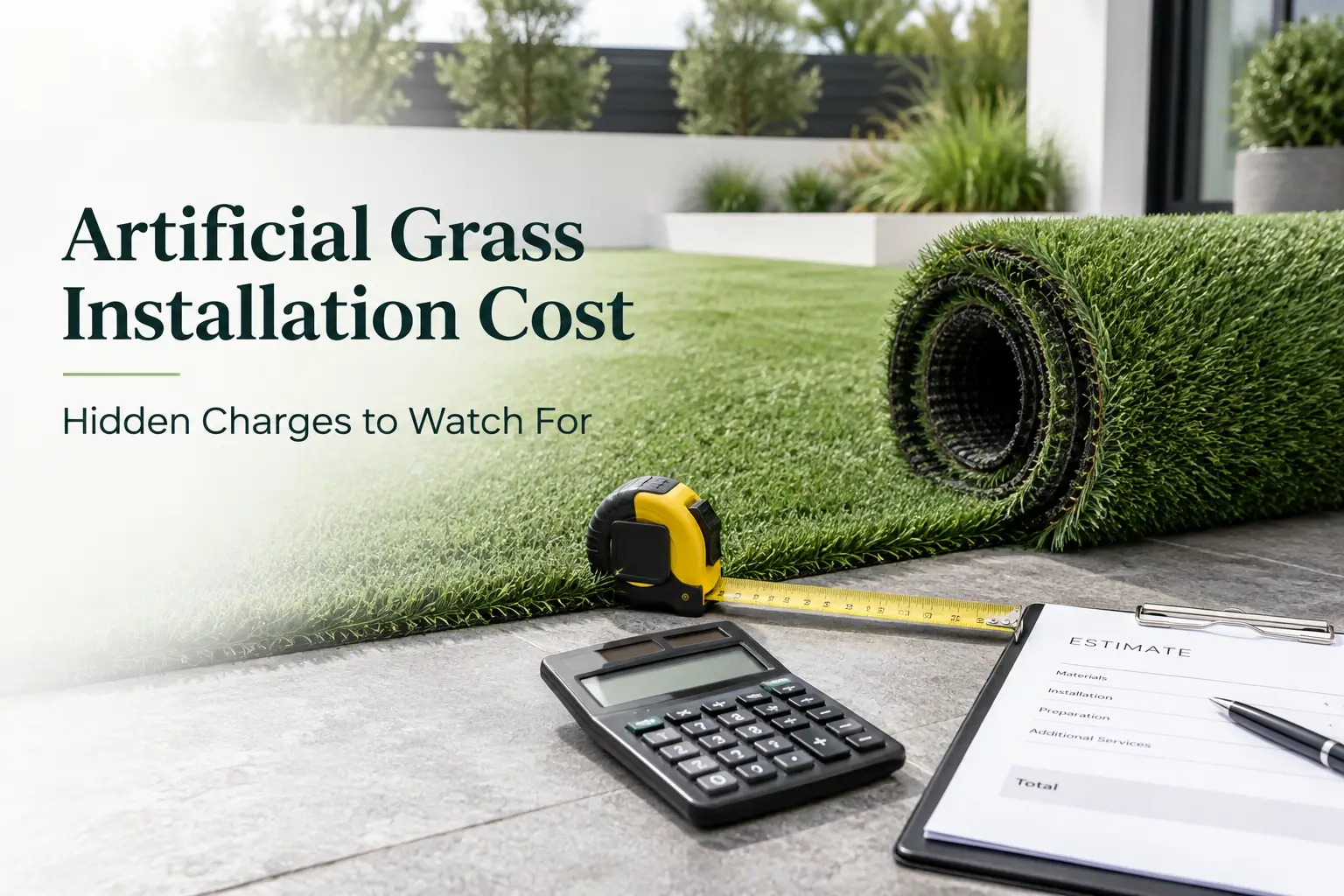
Artificial turf manufacturers often advertise low per-square-foot rates without disclosing the full cost picture. Understanding realistic 2026 pricing in Indian Rupees (₹) is essential for accurate budgeting.
Here is a realistic cost benchmark for the Indian market in 2026:
| Application | Cost Range (₹/sq. ft.) | Notes |
| Football Turf (FIFA Grade) | ₹140 – ₹220 | Includes sub-base, infill & lines |
| Cricket Turf (Practice) | ₹90 – ₹150 | Matting or full carpet system |
| Landscape / Residential | ₹60 – ₹110 | Non-infill or sand-filled |
| Tennis Court (ITF Grade) | ₹160 – ₹240 | Acrylic or synthetic surface |
| Padel Court (Full Build) | ₹18L – ₹28L total | Glass walls + surface + lighting |
| Pickleball Court | ₹3.5L – ₹6L total | Compact layout, multi-sport use |
These are all-inclusive estimates for 2026, factoring in material, labour, sub-base, drainage, and line-marking. Maintenance Annual Management Plans (AMPs) typically range from ₹8,000 – ₹20,000 per year depending on usage intensity and surface area.
6. How Does After-Sales Support Define the Reliability of Artificial Turf Manufacturers?
Artificial turf manufacturers that disappear after delivery are a significant risk in the Indian market, where climate variations — from Delhi’s extreme heat to Cherrapunji’s rainfall — demand ongoing surface management.
Evaluate after-sales support using these benchmarks:
• Minimum 5-year product warranty and 10-year surface performance warranty for institutional projects
• Dedicated AMC (Annual Maintenance Contract) with bi-annual grooming, infill top-up, and seam inspection
• 24-hour response time for warranty claims and damage reports
• Regional service presence in metro cities (Mumbai, Delhi, Bengaluru, Chennai, Hyderabad) and Tier 2 hubs (Indore, Nagpur, Kochi, Coimbatore, Lucknow)
7. Are Artificial Turf Manufacturers Aligned with India’s Sustainability Goals in 2026?
Artificial turf manufacturers must now reckon with India’s net-zero commitments and green building codes. The Indian Green Building Council (IGBC) and GRIHA rating systems increasingly factor in the recyclability and carbon footprint of synthetic surfaces.
In 2026, forward-looking manufacturers are offering:
• 100% recyclable polyethylene yarn that qualifies for IGBC credits
• Reduced heat island effect through reflective backing and bio-based infill
• Rainwater harvesting-compatible drainage grids reducing dependency on municipal water
• REACH-compliant, heavy-metal-free formulations for school and residential applications
At Turf8, we are committed to carbon-neutral installation processes by 2027, with our eco-range already adopted in over 40 IGBC-rated residential projects across Pune, Hyderabad, and Chennai.
8. What Portfolio of Projects Should You Expect from Reputable Artificial Turf Manufacturers?
Artificial turf manufacturers with verified project portfolios across diverse categories — stadiums, schools, residential complexes, and government sports infrastructure — provide the strongest assurance of delivery capability.
In India’s 2026 landscape, key project segments to look for in a manufacturer’s portfolio include:
• Government & Smart City Projects: Municipal sports zones, Khelo India football hubs, Amrit Sarovar lakeside developments
• Educational Institutions: IIT campuses, CBSE school playgrounds, sports academy practice zones
• Residential & Commercial: Premium apartment terraces, IT park green zones, hotel courtyard lawns
• Private Sports Clubs: Football 5-a-side centres, padel clubs, multi-sport academies
Verify that the portfolio includes projects in both metro and Tier 2 / Tier 3 cities. A manufacturer active only in Mumbai or Delhi may lack the regional logistics network to deliver quality consistently in Nagpur, Raipur, or Visakhapatnam.
9. How Should Artificial Turf Manufacturers Handle the Unique Challenges of Indian Climate Zones?
India’s six distinct climate zones — from the sub-zero winters of Ladakh to the tropical humidity of Kerala — demand climate-specific turf engineering. Artificial turf manufacturers who apply a one-size-fits-all approach invariably produce surfaces that underperform within two monsoon cycles.
Climate-specific considerations for 2026:
• North India (Delhi, Punjab, UP): Anti-freeze backing and high UV-resistance for summer temperatures exceeding 48°C
• Coastal India (Mumbai, Chennai, Kochi): Salt-spray resistant yarn coatings and enhanced anti-fungal backing
• Central India (MP, Vidarbha, Chhattisgarh): Superior heat dissipation systems — turf surface temperatures can exceed 75°C in May–June
• NE India & Hills (Assam, Meghalaya, Himachal): High-drainage systems rated for 150mm/hour rainfall capacity
10. Why Is Transparent Pricing and Contractual Integrity Non-Negotiable from Turf Manufacturers?
Artificial turf manufacturers must present itemised, transparent quotations that break down material costs, installation charges, sub-base work, drainage, line-marking, and post-installation services. Bundled or vague pricing is a common source of dispute in India’s turf construction market.
In 2026, a credible quotation from a professional turf manufacturer should include:
• Per-square-metre turf supply cost (in ₹, with GST stated separately)
• Sub-base construction cost (if applicable)
• Installation labour charges with projected timelines
• Maintenance plan pricing for Year 1, Year 2–5, and Year 5+ cycles
• Penalty clauses for delivery and installation delays
• Warranty terms in writing — not verbal assurances
At Turf8, every project begins with a detailed Site Assessment Report and a fully itemised proposal — no hidden costs, no post-installation surprises. Our contractual framework has been audited to meet the procurement standards of CPWD and state PWD bodies, making us a reliable partner for government tenders as well.
Making the Right Choice in India’s Fast-Growing Turf Construction Market
India’s turf construction industry in 2026 is no longer a niche — it is a mainstream infrastructure segment with strong government backing, rising private investment, and growing awareness of performance and sustainability standards.
The 10 criteria outlined in this guide — from certifications and material quality to climate adaptability and transparent pricing — are your essential checklist when evaluating artificial turf manufacturers for any project, large or small.
Whether you are planning a FIFA-certified football ground in Bhopal, a premium residential lawn in Navi Mumbai, a padel court complex in Bengaluru, or a school sports zone in Coimbatore — Turf8’s team of certified turf construction specialists is ready to deliver world-class results at competitive Indian market pricing. Let’s build India’s sporting future together — one perfectly engineered surface at a time.
Frequently Asked Questions (FAQ)
Q1. What is the average cost of artificial turf installation in India in 2026?
The cost of artificial turf installation in India in 2026 ranges from ₹60 to ₹240 per square foot depending on the application. Landscape turf for residential use starts at ₹60–₹110 per sq. ft., while FIFA-grade football turf costs ₹140–₹220 per sq. ft. A full padel court build is typically ₹18–₹28 lakh inclusive of structure, surface, and lighting.
Q2. How long does artificial turf last in Indian climate conditions?
High-quality artificial turf from certified manufacturers typically lasts 8–12 years in Indian conditions with proper maintenance. Turf installed in extreme heat zones (Rajasthan, Vidarbha) may see reduced lifespan to 7–9 years unless UV-stabilised premium yarn is used. Annual maintenance contracts extending from ₹8,000–₹20,000 per year significantly extend surface life.
Q3. Is artificial turf safe for children and pets in Indian schools and homes?
Yes — provided the turf uses REACH-compliant, lead-free, heavy-metal-free yarn and EPDM or organic infill. In 2026, reputable artificial turf manufacturers supply specific child-safe and pet-friendly variants with non-toxic certifications. Always request a material safety data sheet (MSDS) before approving turf for school playgrounds or residential gardens.
Q4. What maintenance does artificial turf require in India?
Artificial turf in India requires quarterly grooming to redistribute infill, bi-annual deep cleaning to prevent bacterial growth in humid climates, and annual inspection of seams and drainage. In high-footfall facilities like football grounds, monthly brushing of pile direction is recommended. Annual maintenance plans (AMPs) cost ₹8,000–₹20,000 per year for standard surfaces.
Q5. How do I verify if an artificial turf manufacturer is certified and credible in India?
Request copies of FIFA Quality Pro, ITF, or AIFF certification for sports surfaces. Ask for BIS compliance certificates for school and government projects. Cross-check the manufacturer’s portfolio with verified client references in your city or region. Credible manufacturers will also provide lab-tested performance data sheets and environmental product declarations.
Q6. Does Turf8 serve Tier 2 and Tier 3 cities in India?
Yes. Turf8 actively serves Tier 2 and Tier 3 cities including Nagpur, Indore, Lucknow, Coimbatore, Visakhapatnam, Raipur, Bhubaneswar, Kochi, and Surat — in addition to all major metros. Visit turf8.in to request a site assessment and customised quotation for your location.