Walk through any new residential township in India today and you’ll likely spot a rooftop garden, a society clubhouse lawn, or a school playground finished in synthetic green. Artificial grass has quietly become one of India’s fastest-adopted landscaping materials, but not every roll of turf on the market is built to the same standard. Choosing the Best Artificial Grass Manufacturer is the single decision that determines whether that lawn looks premium for a decade or fades and flattens within two monsoons.
Best Artificial Grass Manufacturer selection matters more in India than in most markets because of the country’s unique combination of intense summer heat, heavy monsoon rainfall, and high footfall in shared spaces like parks and school grounds. As a company offering premium landscape turf solutions, Turf8 has seen firsthand how the wrong manufacturer choice turns a promising project into a costly redo within a year or two.
This guide walks through exactly what separates a genuinely reliable manufacturer from a budget supplier cutting corners, along with realistic 2026 Indian pricing so you can evaluate quotes with confidence.
Why does choosing the Best Artificial Grass Manufacturer matter in 2026?
Best Artificial Grass Manufacturer selection has become a bigger decision than ever because India’s synthetic turf market has grown rapidly, and with growth has come a flood of new, inconsistent suppliers. Industry estimates put India’s artificial turf market at roughly USD 351.5 million as of 2025, with steady annual growth projected through the next decade as landscaping, sports, and urban development projects scale up.
Best Artificial Grass Manufacturer choice also matters because India’s climate is genuinely demanding on synthetic materials. Peak summer surface temperatures in cities like Delhi, Jaipur, and Nagpur regularly exceed 55–60°C, while monsoon regions along the west and east coasts see months of continuous moisture exposure – conditions that separate durable, UV-stabilized turf from cheaper products that degrade within a few seasons.
Best Artificial Grass Manufacturer decisions increasingly factor in water conservation too, as many Indian municipalities have tightened restrictions on non-essential water use for lawns and public gardens. According to Turf8’s 2026 India market insights, water-scarcity concerns are now one of the top three reasons residential and commercial clients cite when switching from natural grass to synthetic turf.
What should you check before selecting an artificial grass manufacturer?
Best Artificial Grass Manufacturer evaluation should never start with price alone. The most reliable indicator of long-term performance is the manufacturer’s raw material and construction specification, not the headline rate per square foot.
Best Artificial Grass Manufacturer credibility checks should include:
- Material type – polyethylene (PE) fibres are softer, more UV-resistant, and generally outperform cheaper polypropylene (PP) blends for long-term outdoor use
- Density (stitches per square metre) – residential-grade turf should have at least 16,000 stitches/m², and sports-grade turf should exceed 18,000 stitches/m² for durability under heavy use
- UV stabilization – accelerated aging test results of 3,000+ hours indicate the turf will resist fading and brittleness under Indian sun exposure
- Backing and drainage – evenly spaced drainage holes (typically 10–12mm) prevent waterlogging during monsoon
- Warranty length – genuine high-quality turf is typically backed by 8–10 year warranties, while low-cost products often degrade within 3–5 years
People Also Ask: What is the difference between polyethylene and polypropylene artificial grass?
Polyethylene (PE) turf is softer, more flexible, and more resistant to UV damage, making it the preferred choice for lawns, sports fields, and high-traffic areas, while polypropylene (PP) is stiffer and better suited to lower-cost, low-traffic decorative applications.
How much does artificial grass cost in India in 2026?
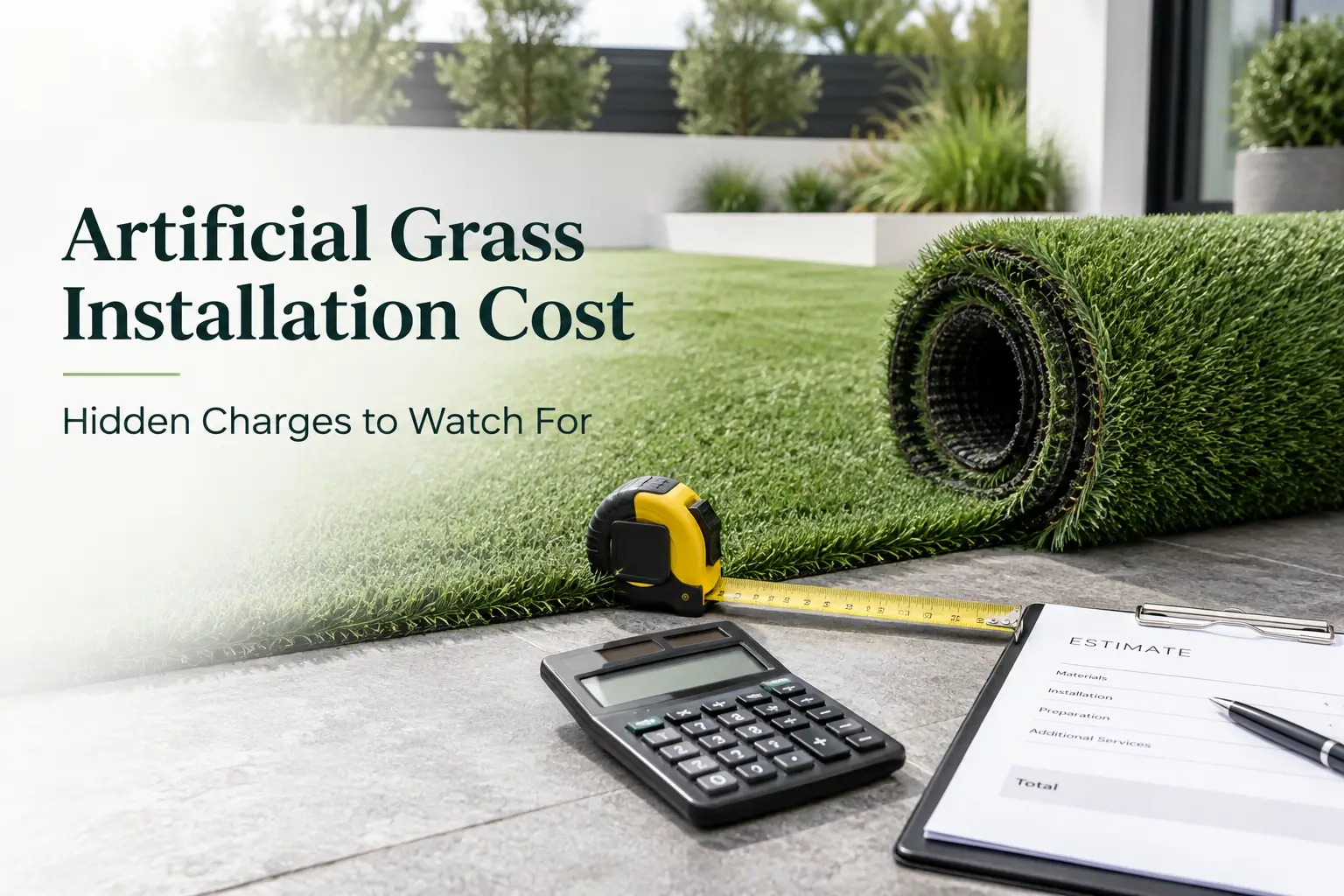
Best Artificial Grass Manufacturer pricing in India in 2026 varies significantly based on material grade, pile height, and application. Here is a realistic cost breakdown property owners can use to sense-check quotes:
| Application | Estimated Cost (per sq. ft.) |
| Basic residential turf (balconies, small lawns) | ₹50 – ₹100 |
| Mid-range turf (gardens, school lawns, semi-commercial) | ₹100 – ₹180 |
| Premium sports-grade turf (football, multi-sport fields) | ₹200 – ₹350 |
| Full installed project cost (with base prep & drainage) | ₹110 – ₹400 |
Best Artificial Grass Manufacturer quotes should always be compared on a like-for-like basis, since a low per-square-foot rate often excludes base preparation, drainage layers, or professional installation labour – costs that typically add ₹100–₹200 per sq. ft. on top of the turf material itself. A genuinely competitive quote will break these components out separately rather than bundling them into one vague number.
Best Artificial Grass Manufacturer partnerships also affect ongoing costs. Annual maintenance for quality turf typically runs ₹10–₹25 per sq. ft. depending on footfall, while turf sourced from an unreliable manufacturer often requires early replacement, effectively doubling the real cost of ownership within five years.
What red flags indicate a low-quality artificial grass manufacturer?
Best Artificial Grass Manufacturer red flags are usually visible before you even sign a contract, if you know what to look for. Watch out for suppliers who cannot provide a written specification sheet, refuse to share test certificates for UV resistance or tuft bind strength, or quote a single flat rate with no breakdown of materials versus labour.
Best Artificial Grass Manufacturer warning signs also include unusually short lead times on large orders, a lack of completed project references you can visit or verify, and pricing significantly below the market range shown above – a strong sign that either material quality or base preparation is being compromised.
People Also Ask: How long does good-quality artificial grass last in India?
High-quality artificial grass with proper UV stabilization and correct installation typically lasts 8 to 10 years in Indian conditions, while low-quality turf can fade, flatten, or turn brittle within 3 to 5 years.
How does Turf8 ensure premium quality turf installation?
Turf8 ensures premium quality turf installation by controlling the two variables that determine long-term performance: material specification and base construction. Every project begins with a site assessment that accounts for drainage needs, sun exposure, and expected footfall before any turf grade is recommended.
Turf8’s advanced turf technology ensures that residential lawns, commercial landscaping, school playgrounds, and sports surfaces each receive a specification matched to their actual use case, rather than a one-size-fits-all product. A rooftop garden and a stadium training pitch have very different performance requirements, and treating them identically is one of the most common mistakes in the Indian turf market today.
At Turf8, we specialize in serving residential complexes, commercial properties, sports stadiums, schools, and government projects across both metro cities and Tier 2/Tier 3 towns, giving our teams practical experience across a wide range of soil types, budgets, and climate conditions found across the country.
Is artificial grass a sustainable choice for Indian landscaping?
Best Artificial Grass Manufacturer choices increasingly factor into sustainability planning, since quality synthetic turf eliminates the need for daily irrigation that natural grass requires, particularly relevant as urban water stress grows across Indian cities. A single natural lawn can consume thousands of litres of water weekly during dry months, while artificial turf requires none.
Best Artificial Grass Manufacturer sustainability credentials also extend to material sourcing, with a growing number of Indian manufacturers now incorporating recycled plastics into backing materials and offering anti-microbial coatings that reduce the need for chemical treatments over the turf’s lifespan.
Frequently Asked Questions
How do I choose the Best Artificial Grass Manufacturer in India?
Look for polyethylene-based turf with at least 16,000 stitches/m² density, UV stabilization test data, proper drainage backing, and an 8–10 year warranty, backed by verifiable completed project references.
What is the average cost of artificial grass installation in India in 2026?
Full installed project costs typically range from ₹110 to ₹400 per sq. ft. depending on turf grade, base preparation needs, and application type.
Is polyethylene or polypropylene artificial grass better?
Polyethylene (PE) is generally better for durability and UV resistance, making it the preferred choice for lawns and sports applications, while polypropylene suits lower-cost decorative use.
How often does artificial grass need maintenance?
Quality artificial grass needs only light brushing, occasional washing, and periodic infill top-up, with annual maintenance costs typically ranging from ₹10 to ₹25 per sq. ft.
Does artificial grass work well in India’s monsoon climate?
Yes, when installed with proper drainage layers and backing with adequately spaced drainage holes, artificial grass performs reliably through heavy monsoon rainfall without waterlogging.
Can artificial grass be used for both landscaping and sports fields?
Yes, though the specifications differ – landscaping turf prioritizes appearance and softness, while sports-grade turf requires higher density, reinforced backing, and shock-absorbing infill for player safety.
Final Thoughts
Choosing the Best Artificial Grass Manufacturer is not a decision to make on price alone, especially in a market as climate-demanding and fast-growing as India’s in 2026. The right manufacturer combines verified material quality, proper base construction, and honest, itemized pricing – the difference between a lawn or sports field that looks premium for a decade and one that needs replacing within two years.
At Turf8, we specialize in exactly that standard of transparency and craftsmanship, helping residential, commercial, and government clients across India build turf surfaces engineered to last through every season the country throws at them.