
Artificial Turf Installation: How to Get Better Drainage, Grip & Durability
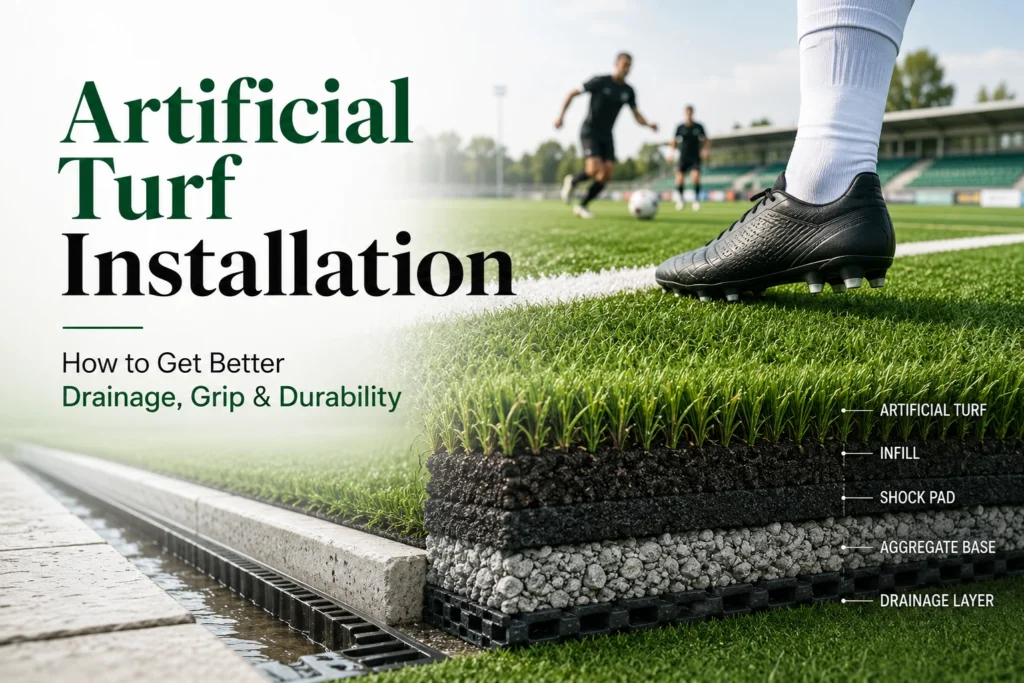
Artificial Turf Installation is no longer a niche landscaping choice in India – it’s fast becoming the default for anyone who wants a green, low-maintenance surface that survives monsoons, heatwaves, and heavy footfall. From residential terraces in Pune to FIH-standard hockey fields in Delhi-NCR, the demand for professionally engineered turf systems is climbing sharply as water scarcity and urban development reshape how India builds outdoor spaces. Artificial Turf Installation done right is about far more than rolling out green plastic grass. It’s an engineered system – base preparation, drainage layers, shock pads, infill, and seam work – that determines whether your lawn, playground, or stadium pitch lasts 3 years or 12. If you’re planning a project, exploring premium landscape turf solutions designed specifically for Indian soil and climate conditions is the smartest first step before you compare quotes. At Turf8, we specialize in end-to-end turf construction – from residential complexes and rooftop gardens to school playgrounds, commercial campuses, and government sports infrastructure – and this guide breaks down exactly what separates a turf installation that performs from one that fails within a monsoon season. Why is professional artificial turf installation important in India in 2026? Artificial Turf Installation matters more in India than almost anywhere else because of the country’s climate extremes – intense summer heat, concentrated monsoon rainfall, and dust. A poorly built base or blocked drainage layer can turn a lawn into a waterlogged mess within a single rainy season. Quick answer (Featured Snippet): Professional artificial turf installation in India is important because it ensures proper drainage during heavy monsoon rainfall, UV-stable performance in extreme summer heat, and long-term durability under heavy foot traffic – all of which DIY or low-cost installations typically fail to deliver. According to Turf8’s 2026 India market insights, India’s artificial turf market is now valued in the range of USD 350-580 million, with growth propelled by rising demand for low-maintenance, heavy-duty grass surrogates across sports complexes, landscaping, and residential applications – driven largely by urbanization, rising disposable income, and growing awareness of water-efficient alternatives to natural grass. Sports applications remain the dominant growth driver, especially FIFA-certified football pitches and FIH-approved hockey fields being built across regional cities as India’s sports infrastructure push accelerates. How does artificial turf installation improve drainage in Indian climates? Artificial Turf Installation quality is judged first on drainage – because in Indian cities, a single heavy monsoon downpour can dump 50-100mm of rain in a few hours. Turf systems must move that water away instantly, not let it pool. A well-engineered drainage system typically includes: Artificial Turf Installation without these layers is the single biggest reason installations fail within a year in India – waterlogging, foul odour, and turf lifting are almost always drainage failures, not turf quality failures. According to Turf8’s 2026 India market insights, over 60% of complaint calls we receive from other providers’ clients trace back to inadequate base preparation rather than the turf material itself. How is grip and player safety engineered into turf construction? Artificial Turf Installation for sports fields, schools, and even residential play areas must balance two things that often work against each other: enough grip to prevent slipping, and enough cushioning to prevent injury on impact. Quick answer: Grip and safety in artificial turf are controlled by pile height, infill density (typically silica sand and SBR rubber granules), and shock-pad thickness – together they determine traction, ball bounce, and impact absorption. Turf8’s advanced turf technology ensures the right combination of these three elements is selected for each use case – a rooftop lawn needs very different specifications than an FIH-certified hockey pitch. Our engineering team’s field experience confirms that infilled turf systems dominate sports applications because a combination of silica sand and SBR rubber granules keeps blades upright under mechanical stress while providing the shock absorption needed to reduce injury risk and meet global sports federation standards for traction and ball bounce. Artificial Turf Installation for schools and residential zones generally uses shorter pile turf (25-35mm) with lighter infill for comfort and safety around children, while stadium-grade installations use taller pile (40-60mm), heavier infill, and shock pads engineered for FIFA/FIH quality certification. How much does artificial turf installation cost in India in 2026? Artificial Turf Installation costs in India vary widely based on turf grade, base preparation needs, drainage complexity, and site size. Based on 2026 Indian market estimates, typical price ranges are: Project Type Estimated Cost (₹ per sq. ft) Residential landscaping turf (balcony/lawn) ₹55 – ₹110 Rooftop/terrace turf with drainage layer ₹90 – ₹160 Commercial landscaping (office campuses, resorts) ₹100 – ₹180 School playgrounds (multi-purpose) ₹150 – ₹280 Sports-grade turf (football, FIFA-quality) ₹350 – ₹600 Hockey turf (FIH water-based/sand-filled) ₹550 – ₹900 Artificial Turf Installation for full stadium or government sports complex projects often runs into ₹1.5-6 crore depending on scale, drainage engineering, floodlighting, and certification requirements. Annual maintenance plans in India typically range from ₹8,000-₹25,000/year for residential setups to ₹1.5-4 lakh/year for sports facilities, covering brushing, infill top-ups, and deep cleaning. Artificial Turf Installation pricing should always be compared on a like-for-like basis – a ₹55/sq.ft quote without base preparation and drainage work is not comparable to a ₹110/sq.ft quote that includes it. At Turf8, we specialize in transparent, itemized quotes so residential and commercial clients across metro and Tier 2/Tier 3 cities know exactly what they’re paying for. How does Turf8 ensure premium quality artificial turf installation? Artificial Turf Installation quality depends on process discipline, not just good-looking turf rolls. Turf8’s advanced turf technology ensures consistency across every project – whether it’s a residential society in Kolhapur or a government sports complex in a Tier 2 city – through a structured five-stage process: According to Turf8’s 2026 India market insights, projects that skip stages 1 and 2 account for the vast majority of drainage failures reported industry-wide within the first two monsoon seasons. This is why Turf8 positions itself as a premium, engineering-led turf construction company rather than a turf retailer – the installation process matters