
Multi Sports Turf Installation in Mumbai: Everything You Need to Know
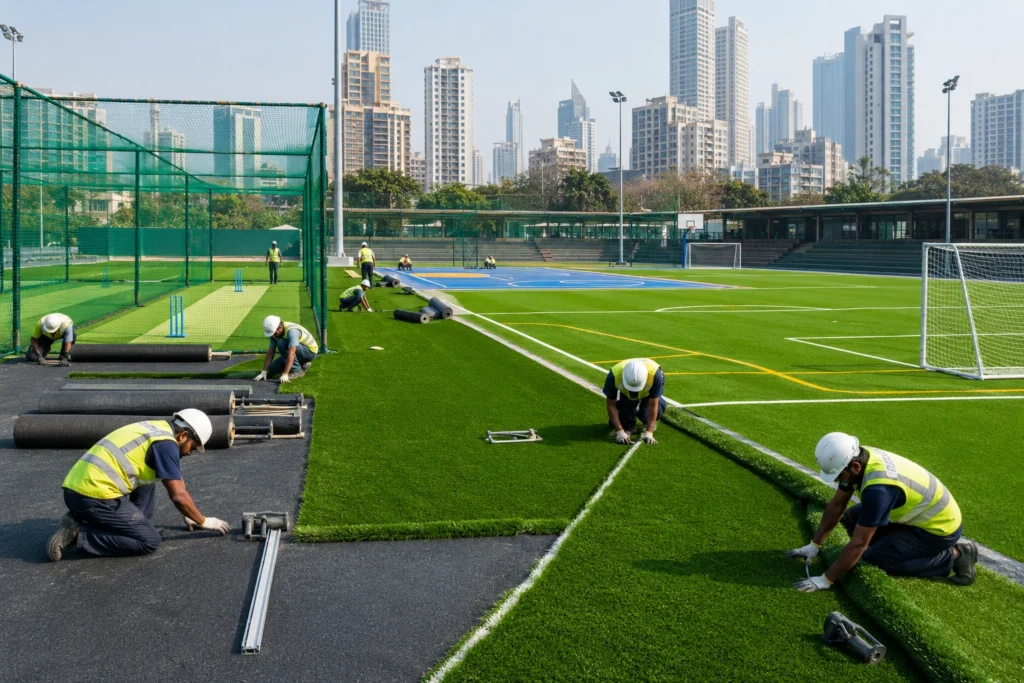
Multi sports turf installation is reshaping how Mumbai plays. Across the city’s residential towers, school campuses, corporate parks, and municipal grounds, a single well-designed synthetic surface is now replacing what once required four or five separate specialised facilities – saving space, slashing costs, and dramatically increasing sports participation at every level. Mumbai faces a unique infrastructure paradox: one of the world’s most sports-enthusiastic cities packed into one of its most land-constrained urban footprints. With available open space at an absolute premium across the MMR (Mumbai Metropolitan Region), multi-use synthetic surfaces have emerged as the single most efficient solution for maximising sporting utility per square metre. India’s sports infrastructure market is projected to grow to ₹22,500 crore by 2027, according to the FICCI-EY Sports Industry Report 2025, with multi-sport facilities accounting for the fastest-growing sub-segment. For property developers, school boards, housing societies, and municipal bodies across Mumbai and its satellite cities, understanding how multi sports turf installation works – and how to get it right – has never been more important. At Turf8, we specialise in designing and constructing multi-sport turf surfaces across Mumbai, Navi Mumbai, Thane, and the wider Maharashtra region. This complete guide covers everything you need to know before commissioning a project in 2026. What Is Multi Sports Turf Installation and Why Is It Gaining Momentum in Mumbai? Multi sports turf installation refers to the design and construction of a single synthetic surface engineered to accommodate two or more sports – typically using overlapping line-marking systems, adjustable net posts, and surface specifications that balance the performance demands of each sport it hosts. A well-executed multi-sport surface in a typical Mumbai housing society or school might host football (5-a-side), basketball, volleyball, badminton, and cricket practice – all on a single 800–1,200 sq. ft. to 5,000+ sq. ft. footprint. The same surface used for a futsal match at 7am can host a volleyball tournament by evening, with no downtime or reconfiguration required beyond switching nets. Mumbai’s land economics make this format not just attractive but often the only viable sports infrastructure option. Prime land in areas like Andheri, Powai, Malad, and Navi Mumbai’s Kharghar township commands ₹8,000–₹25,000 per sq. ft. in property cost – making the efficient use of every square metre of open space an absolute financial priority for developers and housing society committees alike. What Sports Can Be Included in a Multi Sports Turf Installation? Multi sports turf installation in Mumbai typically encompasses a combination of the following sports, with the exact mix determined by available space, target user group, and budget: Most Common Sport Combinations: Sport-Specific Turf Requirements: Each sport places different demands on the surface, and reconciling them is the core engineering challenge of multi-sport turf design: Sport Pile Height Key Surface Need Football / Futsal 40–60mm Traction, ball roll, shock absorption Basketball Short pile / hard court Firm, consistent ball bounce Volleyball 12–20mm or hard surface Knee-safe cushioning, stability Badminton Short pile / synthetic mat Non-slip, low pile resistance Cricket 12–20mm True ball bounce, foot stability Tennis 12–20mm Ball pace consistency, traction Because different sports perform optimally on different specifications, professional multi-sport turf design involves selecting a hybrid surface specification that meets the minimum performance threshold for every sport in the mix – not the ideal for any single sport. This is a nuanced engineering decision that only experienced turf constructors can navigate correctly. How Is a Multi Sports Turf Surface Engineered for Multiple Sports? Multi sports turf installation requires a carefully layered construction system – not just a single turf product laid on a flat surface. Here is how a professional installation is structured from ground up: Layer 1: Sub-grade Preparation The existing ground is excavated to 150–200mm depth, levelled, and compacted to a minimum CBR (California Bearing Ratio) of 80%. Poor sub-grade preparation is the primary cause of surface undulation, drainage failure, and premature turf degradation in Mumbai’s monsoon climate. Layer 2: Aggregate Base Course A 100–150mm layer of compacted stone aggregate (20mm graded stone) provides structural load distribution and primary drainage. In Mumbai, where monsoon rainfall can exceed 300mm in a single day, drainage capacity in the base layer is critical – standard specification is a minimum permeability of 600mm/hour. Layer 3: Shock Pad (For Sports Applications) A 10–15mm closed-cell EPDM foam shock pad is installed on top of the aggregate base for multi-sport applications. This layer performs two critical functions: absorbing impact energy to protect player joints, and providing the vertical deformation characteristics required by FIFA, ITF, and BWF performance standards. Layer 4: Synthetic Turf or Sport Surface For multi-sport surfaces that include football, a 40–55mm PE monofilament turf is typically specified. For surfaces that combine court sports (basketball, volleyball, badminton) with field sports (football, cricket), a shorter 20–35mm pile or a dual-zone surface design is used – with different surface materials in different zones of the court. Layer 5: Infill System Calibrated silica sand (base layer) topped with EPDM rubber granules provides the infill system for sports turfs. Infill depth is calibrated per sport zone where dual specifications are used. Layer 6: Line Marking Multi-sport line marking uses a colour-coded system to prevent confusion between sports: Lines are either cut and filled with coloured yarn during turf manufacturing (the most durable method) or applied as polyurethane paint post-installation (lower cost, shorter lifespan). Turf8‘s advanced turf technology ensures all multi-sport surfaces use in-yarn coloured line marking as the standard, avoiding the fading and peeling issues that affect painted line systems in Mumbai’s humid coastal climate within 18–24 months. What Does Multi Sports Turf Installation Cost in Mumbai in 2026? Multi sports turf installation costs in Mumbai vary based on surface area, sports configuration, surface specification, base conditions, and whether floodlighting and fencing are included. Here are realistic 2026 benchmarks: Project Type Area Surface Spec Estimated Cost Compact 2-sport court (football + basketball) 600–800 sq. ft. 40mm PE turf ₹6 – ₹12 lakh Standard 3-sport court (football + basketball + volleyball) 2,000–3,000 sq. ft. 40–45mm PE turf ₹18 – ₹32 lakh