
Top Benefits of Modern Football Turf Construction for Sports Facilities
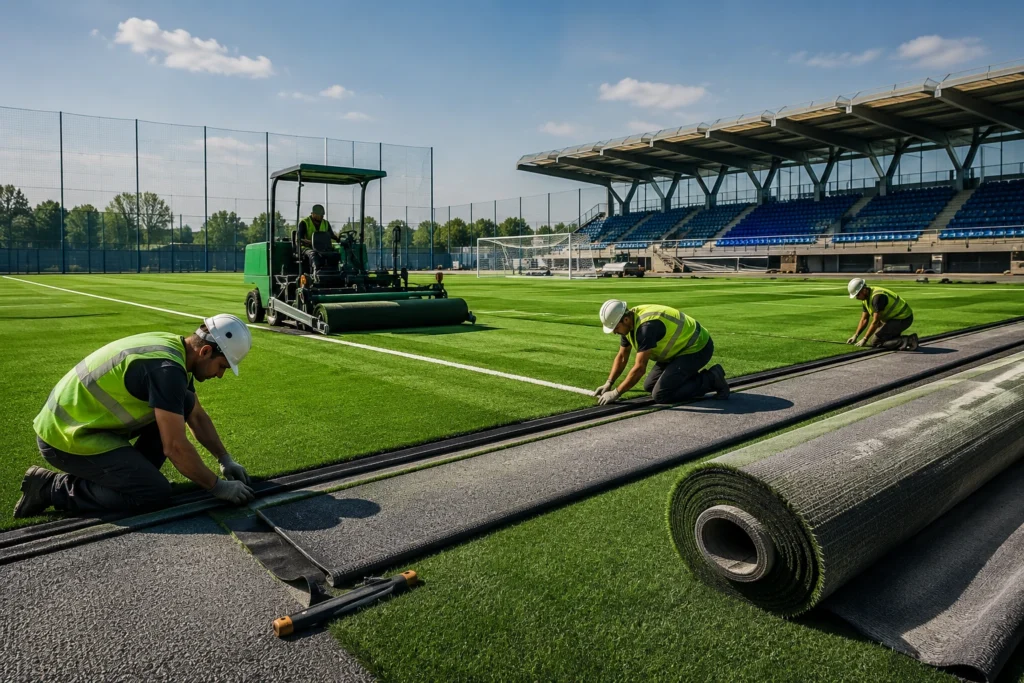
Football turf construction in India has undergone a quiet revolution over the past decade – and in 2026, it’s accelerating faster than ever. From FIFA-standard pitches rising in Mumbai’s suburbs to all-weather training grounds in small towns across Uttar Pradesh and Tamil Nadu, synthetic football turf has become the infrastructure backbone of India’s sporting ambitions. India’s sports infrastructure investment crossed ₹14,200 crore in 2025–26, driven by the Central Government’s Khelo India programme, state-level sports policies, and a rapidly growing private sports academy ecosystem. Football, once overshadowed by cricket, is now one of the fastest-growing participation sports in the country – with over 1.4 crore registered players as of 2025, according to the All-India Football Federation (AIFF). At Turf8, we specialize in professional football turf construction for schools, clubs, academies, municipalities, and stadium operators across India. Whether you’re building a neighborhood 5-a-side cage in Bengaluru or a full-size FIFA-grade pitch in Guwahati, this guide walks you through every major benefit of modern synthetic football turf – and why getting the construction right matters more than ever. Why Is Football Turf Construction Transforming Sports Facilities in India in 2026? Football turf construction is transforming how India plays, trains, and competes. Natural grass pitches, long the standard for football, are simply not viable across most of India – inconsistent rainfall, clay-heavy soils, intense UV exposure, and the sheer volume of daily usage make them expensive to maintain and nearly impossible to sustain at community level. The shift is backed by data. According to the Ministry of Youth Affairs and Sports Infrastructure Report 2025, over 74% of new football grounds built under government programmes in the last three years used synthetic turf rather than natural grass. The economics are compelling: a natural grass football pitch in India requires ₹4.5 lakh to ₹9 lakh in annual maintenance, while a professionally installed synthetic pitch brings that figure down to ₹1.2 lakh to ₹3.5 lakh per year – a saving of up to 60%. Modern synthetic turfs also meet international performance standards that natural grass in India’s climate simply cannot reliably deliver – making them the only realistic option for competitive and development-level football. What Are the Top Benefits of Modern Football Turf Construction? 1. All-Weather Playability – 365 Days a Year Football turf construction using high-quality synthetic fibres delivers consistent playability regardless of season. Mumbai’s monsoon, Rajasthan’s summer heat, or Delhi’s winter fog – none of it disrupts a well-engineered synthetic pitch. Natural grass in India typically allows 90–120 days of reliable play per year in most climates. A FIFA-grade synthetic pitch delivers 330–365 days of usable surface per year, dramatically increasing return on investment for academies, clubs, and facility operators. For commercial football turf businesses, this translates directly to revenue: a 5-a-side turf facility running 14 hours per day at ₹800–₹1,500 per hour can generate ₹35–₹70 lakh annually – impossible on an unreliable natural grass surface. 2. Dramatically Reduced Maintenance Costs Football turf construction with premium synthetic fibres eliminates the largest recurring cost of sports facility operations: groundskeeping. Natural grass football pitches require: Synthetic turf, by contrast, requires: Total annual maintenance for a full-size synthetic football pitch (approx. 7,000 sq. m.): ₹2.5 lakh – ₹4.5 lakh – compared to ₹7 lakh – ₹12 lakh for natural grass equivalents in Indian conditions. 3. Superior Player Safety and Performance Surfaces Football turf construction today goes far beyond laying grass fibres on sand. Modern systems are engineered as multi-layer performance surfaces designed to reduce injury risk while maximising ball roll, traction, and shock absorption. A FIFA Quality Pro-certified pitch, for instance, must pass rigorous laboratory and field tests for: Turf8’s advanced turf technology ensures every football pitch we construct uses EPDM rubber infill – the gold standard for shock absorption – combined with UV-stabilised, lead-free polyethylene fibres that remain soft and non-abrasive even in high-intensity play. According to a 2024 FIFA infrastructure study, properly installed synthetic pitches with shock-pad underlays reduced lower-limb injury rates by up to 22% compared to poorly maintained natural surfaces – critical information for academies and clubs with duty-of-care responsibilities. 4. Water Conservation at Scale Football turf construction with synthetic systems is one of the most impactful water-saving interventions available to sports facility operators in India. A standard 11-a-side natural grass football pitch requires approximately 2.5 to 4 million litres of water annually for irrigation in India’s climate zones. Synthetic turf requires zero irrigation – only occasional washing for hygiene on high-use pitches. At a time when India’s major cities face increasing water stress (per the NITI Aayog Composite Water Management Index 2025), this makes synthetic turf not just operationally smart but environmentally responsible. Many LEED-certified commercial developments, smart city projects, and institutional campuses are now mandating synthetic sports surfaces specifically for their water impact credentials. 5. Faster Project Completion and Scalability Football turf construction timelines are dramatically shorter than natural grass pitches. A professionally managed synthetic turf project of full-size pitch dimensions (approximately 100m × 68m) can be completed in 25–40 working days from base preparation to handover – including drainage, sub-base compaction, turf laying, infill installation, and line marking. Natural grass pitches require 6–12 months of growing-in period before full use, plus ongoing restrictions on usage intensity during the first season. For academies, clubs, and developers working to tight opening schedules and commercial timelines, this difference is decisive. At Turf8, we have delivered multi-pitch projects – including two parallel 5-a-side courts and a full-size ground – within six weeks of mobilisation, a timeline that no natural grass contractor can match. 6. Long Product Lifespan and Strong ROI Football turf construction, when done correctly, delivers a surface lifespan of 10–18 years. Entry-level synthetic turfs using cheaper yarn and inadequate base preparation may degrade in 5–7 years – which is why choosing a qualified contractor matters enormously. Here’s how the numbers stack up over a 15-year horizon for a typical 5-a-side commercial turf facility in a Tier 1 Indian city: Cost Factor Natural Grass Premium Synthetic Turf Initial construction ₹12–18 lakh ₹22–35 lakh