
Tennis Court Construction Mistakes You Must Avoid
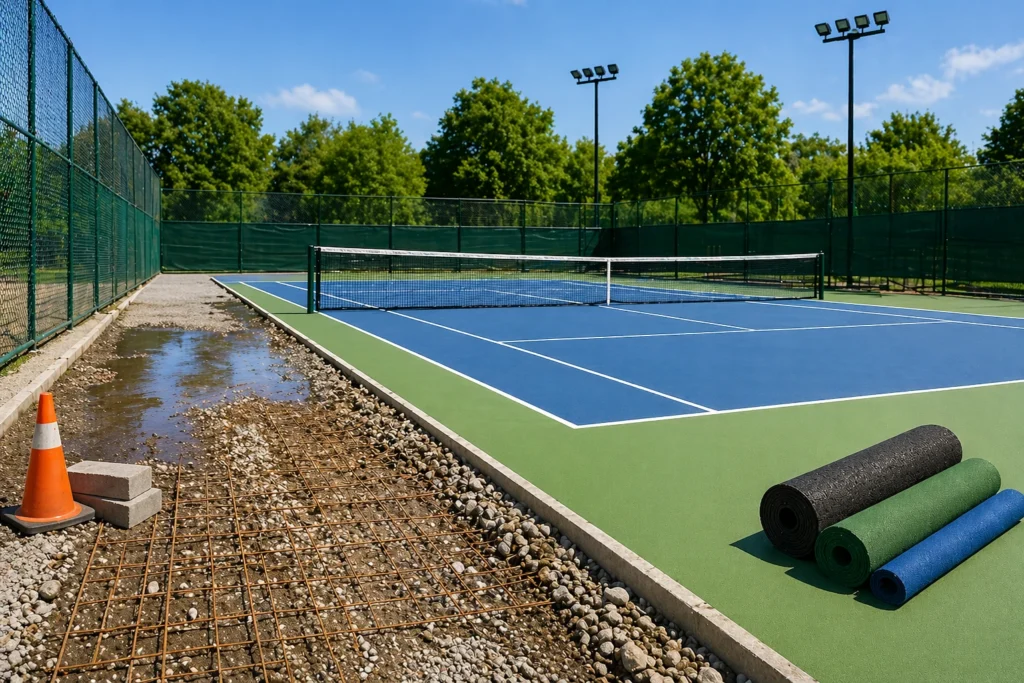
Tennis court construction is one of the most technically demanding sports infrastructure projects you can undertake – and one of the most rewarding when done right. Across India’s housing societies, private academies, school campuses, and government sports complexes, demand for quality tennis courts is accelerating sharply. India’s tennis equipment market is projected to grow at a CAGR of 7.1% through 2035, driven by rising sports academy investment, growing youth participation, and the increasing success of Indian players on the international stage. Yet despite this momentum, a significant number of tennis courts being built across India – particularly in Tier 2 and Tier 3 cities where awareness of professional construction standards is still catching up – are falling prey to the same preventable mistakes. Flat surfaces that flood after rain. Bases that crack within two seasons. Surface coatings that peel, fade, or blister. Courts that are dimensionally incorrect and therefore ineligible for competitive play. The result? Facility owners who invested significantly are facing expensive repairs, dissatisfied players, and in some cases, complete reconstruction. This guide breaks down the most critical tennis court construction mistakes made in India – and how to avoid every single one. If you want the peace of mind that comes from getting it right the first time, explore Turf8’s professional tennis court construction services – built to ITF standards, engineered for Indian conditions, and backed by a team with deep experience across metro and Tier 2/3 markets. Why Is Professional Tennis Court Construction Critical in India in 2026? Tennis court construction mistakes are far more consequential than they appear on the surface – literally. A tennis court is a precision sports system with multiple engineered layers, each performing a specific function. Unlike a football field where minor surface irregularities are forgivable, a tennis court demands millimetre-level consistency in surface slope, complete uniformity of bounce, and a drainage system precise enough to clear standing water within minutes. India’s climate makes these demands even more unforgiving. Courts in Mumbai or Chennai endure extreme humidity and monsoon downpours. Those in Rajasthan, Delhi, or Vidarbha bake under summer temperatures exceeding 45°C. Courts in hill stations or northern plains face frost in winter. A court that is not engineered for its specific location will not survive even its first full annual cycle. Mistakes made in the planning and construction stages can lead to irreversible costs later. This is why professional expertise – from feasibility assessment through to final surface commissioning – is non-negotiable. Mistake #1: Ignoring ITF Dimensions and Court Orientation Tennis court construction must begin with getting the dimensions exactly right. This sounds obvious – yet it remains one of the most common errors across India, particularly in projects managed by general civil contractors without sports infrastructure expertise. The official ITF-standard tennis court measures 23.77 metres × 10.97 metres for doubles play. Including the mandatory run-off zones and safety margins around the playing area, the total recommended footprint is 36.6 metres × 18.3 metres – or approximately 120 ft × 60 ft. Errors in marking out this space, even by a fraction, produce a court that is non-compliant for competition and creates unfair playing conditions that frustrate regular players too. Court orientation is equally important and frequently overlooked. Courts should ideally be oriented on a north–south axis to prevent players from facing direct sun during play. A court built on an east–west axis creates severe sun glare problems for players at either end during morning and evening sessions – prime playing times in India’s hot climate. What this mistake costs you: A court with incorrect dimensions or poor orientation cannot host formal competitions. It affects player experience daily and erodes the facility’s reputation among serious players. At Turf8, we specialize in site planning that begins with a detailed feasibility assessment – covering available space, shadow analysis, wind direction, and site orientation – before a single mark is made on the ground. Mistake #2: Weak or Improperly Prepared Base Tennis court construction quality is determined more by what lies beneath the surface than what players see on top. The base is the backbone of the entire facility, and inadequate base construction is the leading cause of early court failure across India. In India, weak soil and poor drainage are the primary reasons courts crack prematurely. Before any base layer is laid, the existing soil must be properly assessed, excavated to the required depth, and compacted using mechanised equipment. Organic topsoil – which is unstable because it rots and compresses – must be completely removed. A professional tennis court base typically follows this layered sequence: Concrete is the preferred base material for outdoor tennis courts in India. Concrete offers long-term stability and durability in India’s extreme weather conditions. Asphalt, while less expensive initially, deteriorates faster under the combination of heat, UV radiation, and monsoon saturation common across the subcontinent. What this mistake costs you: A weak or poorly prepared base leads to surface cracking, settlement, and uneven bounce – often within the first two monsoon seasons. Full base reconstruction is the only solution and significantly exceeds the savings made by cutting corners at the start. Mistake #3: Getting the Drainage Design Wrong Tennis court construction without correct drainage design is one of the most damaging – and most common – errors in India. The greatest single factor in the deterioration of recreational surfaces is the presence of standing water on or beneath the surface, and this principle applies with particular force in India’s high-rainfall regions. An outdoor tennis court must carry a surface slope of 0.5%–1.0% (typically 1:100) from one side or from the centre toward the edges. This barely perceptible gradient is precisely calibrated – steep enough to drain rainwater efficiently, gentle enough not to create a noticeable playing incline. The International Tennis Federation specifies this slope range clearly in its court construction guidelines. In India, many courts are built completely flat – either because the contractor lacks awareness of ITF slope requirements, or because laser levelling equipment is not used.