
Cricket Turf Construction for Academies: What You Must Know
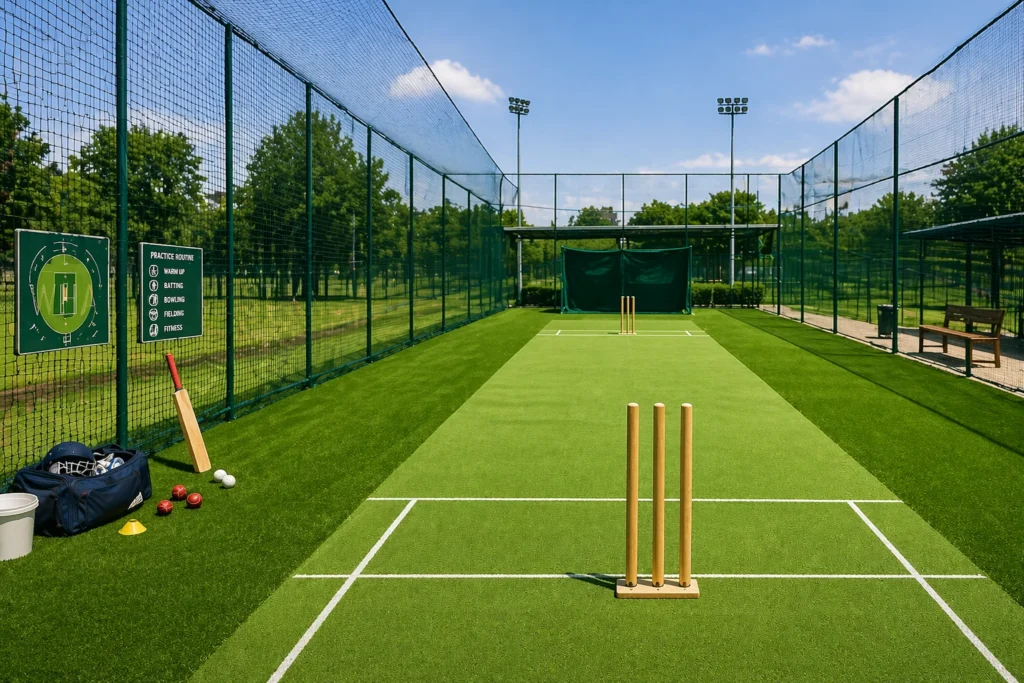
Cricket turf construction is one of the most consequential decisions an academy owner, school principal, or sports entrepreneur will ever make. Get it right, and you create a facility that attracts top coaches, produces competitive players, and generates sustainable revenue for a decade or more. Get it wrong – with the wrong material, a poorly prepared base, or an unreliable contractor – and you’re looking at costly repairs, player safety hazards, and a ground that fails to survive its first monsoon. India’s cricket ecosystem has never been more vibrant, or more demanding of quality infrastructure. In 2026, cricket academies in India play a crucial role in providing structured coaching, fostering technical development, and giving competitive exposure to aspiring players, with demand rising sharply across metro and Tier 2 cities alike. The Union Budget 2026–27 has allocated a record ₹4,479.88 crore to the Ministry of Youth Affairs and Sports under the newly launched Khelo India Mission – a 10-year national transformation plan that places sports infrastructure at the very centre of India’s developmental agenda. Whether you are planning a 4-lane net facility in Pune, a box cricket arena in Kochi, or a full academy campus in Lucknow, understanding how cricket turf is built – and what separates a world-class installation from a mediocre one – is the first step toward making the right investment. Start that journey with Turf8’s expert cricket turf construction services – a trusted partner for academies, schools, and sports facilities across India. Why Does Turf Quality Define an Academy’s Reputation in 2026? Cricket turf construction directly shapes how an academy is perceived by players, parents, and coaches – and in 2026, that perception matters enormously. India’s finest cricket academies now emphasise infrastructure and modern facilities as a key differentiating factor. Parents searching for a cricket academy today evaluate pitches, net quality, and surface consistency just as closely as coaching credentials. A poor-quality turf surface signals poor management. It produces inconsistent ball behaviour that confuses players rather than preparing them. It creates uneven bounce that causes injuries. And it deteriorates fast, eroding both the facility’s playing quality and the academy owner’s return on investment. Conversely, a well-built synthetic cricket surface – properly specified, correctly installed, and professionally maintained – produces the consistent ball behaviour that genuinely prepares players for competitive match conditions. Turf prepares players for real match conditions and league cricket, making it an essential ingredient in any academy’s talent development programme. What Are the Essential Components of Professional Cricket Turf Construction? Cricket turf construction is a layered engineering process. Understanding each layer helps academy owners make informed decisions – and ask the right questions of any contractor they consider. Layer 1: The Sub-grade and Ground Preparation The entire performance of a cricket surface depends on what lies beneath it. The sub-grade must be levelled and compacted to remove undulations greater than ±10mm across the playing surface. Any hollows or rises that survive ground preparation will telegraph through all subsequent layers, causing uneven bounce and accelerating wear. In Indian conditions – where soil types vary from black cotton soil in Maharashtra to sandy alluvial soil in the Gangetic plains – ground preparation complexity varies significantly. Academy owners in cities like Nagpur or Bhopal, which sit on expansive black cotton soil, need particular attention paid to geotextile membranes that prevent subgrade movement during and after monsoon saturation. Layer 2: The Sub-base (Aggregate Base) A compacted aggregate stone sub-base – typically 150–200mm of crusher-run stone or equivalent – sits above the prepared sub-grade. This layer provides structural stability, load distribution, and the primary drainage pathway for surface water. Civil work for ground preparation and aggregate sub-base typically accounts for 20–30% of total cricket turf construction cost. This is not a layer to economise on – a weak sub-base is the most common cause of surface settlement, seam separation, and drainage failure in Indian turf installations. Layer 3: The Drainage System India’s monsoon demands that cricket turf drainage be designed conservatively. Even in drier regions like Rajasthan or Gujarat, a single unseasonal downpour can leave a poorly drained facility waterlogged for days – cancelling coaching sessions and accelerating sub-base deterioration. A professional drainage system includes perforated lateral drain pipes laid at 3–5 metre intervals beneath the sub-base, sloped toward a perimeter collection channel or sump. The surface itself should carry a cross-fall of 0.5–1.0% to direct runoff toward these laterals. For enclosed box cricket facilities with roof structures, internal drainage channels and downpipes are also critical. Layer 4: The Synthetic Turf Surface The turf product itself – pile height, fibre type, density, and infill – must match the intended use. For cricket net lanes and practice pitches, a 12–20mm nylon or polypropylene surface on a concrete or bound base is the industry standard. For outfield areas in larger grounds, 25–40mm polyethylene turf with sand infill offers better aesthetics, comfort for fielders, and ball run-off characteristics. At Turf8, we specialize in matching the correct turf specification to each distinct zone of a cricket facility – pitch, run-up, outfield, and surround – ensuring every surface performs exactly as expected in competitive use. How Much Should an Academy Budget for Cricket Turf Construction in 2026? Cricket turf construction costs depend on facility type, size, location, turf grade, and additional infrastructure. Below are realistic 2026 Indian market estimates, broken down by the most common academy configurations: Net Practice Facilities The backbone of most Indian cricket academies, net lanes are available in multiple configurations: Configuration Approximate Area 2026 Budget Range 2-lane basic net setup 60 ft × 22 ft ₹3.5–₹6 lakh 4-lane academy complex 60 ft × 45 ft ₹8–₹15 lakh 6-lane professional facility 60 ft × 70 ft ₹14–₹24 lakh 6-lane + LED floodlighting 60 ft × 70 ft + lights ₹18–₹32 lakh These estimates include turf surface, concrete or bound base, net poles, netting, and basic perimeter fencing. Shock pad installation at the bowler’s landing zone – strongly recommended for academies with high-intensity bowling loads – adds ₹1–₹2.5 lakh. Box Cricket Arenas