
Sports Turf Construction Mistakes That Can Cost You Lakhs
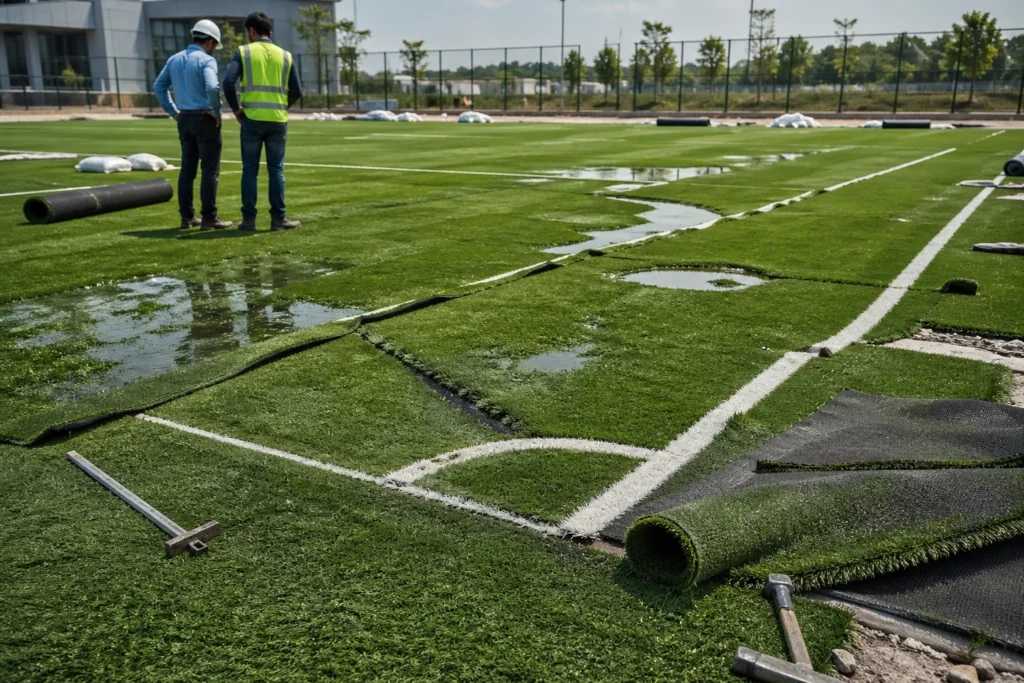
Sports turf construction is one of the fastest-growing segments in India’s infrastructure landscape – and for good reason. Whether it’s a football ground in Pune, a cricket practice facility in Lucknow, or a multi-sport complex in Bengaluru, the demand for high-quality playing surfaces has never been higher. Yet, despite this growth, many developers, school administrators, and sports facility owners end up spending ₹5–15 lakh more than necessary – not because of premium choices, but because of costly, avoidable mistakes. India’s artificial turf market was valued at over ₹2,800 crore in 2024 and is projected to grow at a CAGR of 7.3% through 2030, according to market research published in January 2026. But rapid growth also means a surge in unqualified contractors, substandard materials, and installation errors that compromise both performance and longevity. If you’re planning a turf project – for a residential complex, school, stadium, or government sports facility – this guide is your roadmap to making the right decisions. And if you want to work with a partner that gets it right the first time, explore Turf8’s professional sports turf construction services trusted by clients across India’s metro and Tier 2/Tier 3 cities. Why Is Professional Sports Turf Construction Important in India in 2026? Sports turf construction in India has evolved dramatically over the past five years. The Khelo India initiative, SAI’s nationwide infrastructure upgrades, and rising private investment in sports academies have created enormous demand for quality playing surfaces. But quantity without quality is a recipe for disaster. A poorly built turf field doesn’t just look bad – it creates safety hazards for players, inflates long-term maintenance costs, and often requires full replacement within 3–4 years instead of lasting the standard 8–12 years. According to Turf8’s 2026 India market insights, nearly 40% of sports turf complaints received by installation companies relate to drainage failures, seam separation, or incorrect infill selection – all of which are entirely preventable with the right expertise. What Are the Most Common Sports Turf Construction Mistakes in India? Mistake #1: Skipping the Site Assessment and Soil Testing Sports turf construction begins long before a single blade of grass is laid. The foundation – literally – is the subgrade preparation. Many low-cost contractors skip soil testing and site grading, leading to uneven surfaces, waterlogging, and drainage failure. In India’s varied climate, this is especially dangerous. A football ground in Chennai faces monsoon flooding risks. A rooftop turf in Mumbai must account for load-bearing capacity. A school ground in Jaipur needs to handle extreme summer heat and dust. What this mistake costs you: Waterlogging-related repairs can run ₹2–4 lakh per season. Full resurfacing due to subgrade failure can cost ₹8–20 lakh depending on field size. At Turf8, we specialize in comprehensive site surveys before every project – covering soil composition, drainage gradients, slope analysis, and local climatic data – ensuring your turf performs from day one. Mistake #2: Choosing the Wrong Turf Pile Height and Infill Not all artificial turf is created equal. Sports turf construction requires matching the turf specification to the sport being played. A 40mm pile height with rubber crumb infill works well for football. But that same turf on a hockey field or cricket ground is a performance and safety liability. In India, many buyers focus only on price per square foot (typically ranging from ₹350 to ₹1,200/sq. ft. depending on grade) without understanding fiber denier, pile density, or infill type. The result? Turf that looks good in the showroom but wears out in 18 months under regular play. The right specification by sport (2026 Indian market estimates): What this mistake costs you: Replacing an incorrectly specified 5,000 sq. ft. field can cost ₹25–50 lakh, including removal, disposal, and reinstallation. Mistake #3: Ignoring the Shock Pad and Sub-Base Layer Sports turf construction professionals know that what lies beneath the turf is as important as the surface itself. A proper shock-absorbing pad (also called a shockpad) reduces player injury risk, improves ball bounce consistency, and significantly extends turf life. Many budget installations in India skip this layer entirely. On paper, the project looks cheaper – saving ₹80–₹150 per sq. ft. at installation. In reality, you’re looking at higher injury rates, faster fiber wear, and non-compliance with FIFA, FIH, or ITF standards for competitive play. What this mistake costs you: Player injury liability, loss of eligibility for competitive fixtures, and early turf degradation adding ₹10–30 lakh in replacement costs within 4–5 years. Turf8’s advanced turf technology ensures every installation includes the correct shock pad specification, sub-base compaction testing, and drainage layer engineering – matching international sports federation standards. Mistake #4: Hiring Unlicensed or Inexperienced Contractors The surge in demand for sports turf across India has unfortunately created a parallel surge in unqualified contractors who offer temptingly low quotes. They may use imported turf of unknown specification, install without a warranty, and disappear before defects surface – which typically happens within the first monsoon season. In Tier 2 and Tier 3 cities like Indore, Coimbatore, Nashik, or Bhubaneswar, where sports infrastructure investment is rising rapidly, this problem is especially acute. Local contractors may lack the equipment, training, or supply chain access to deliver consistent results. Red flags to watch for: What this mistake costs you: A failed installation on a 1,000 sq. ft. court can set you back ₹3–7 lakh. A failed stadium-size project can mean losses exceeding ₹50 lakh, plus reputational damage for the project developer. Mistake #5: Neglecting Post-Installation Maintenance Planning Sports turf construction doesn’t end at installation. Artificial turf, despite being low-maintenance compared to natural grass, requires regular grooming, infill redistribution, seam inspection, and periodic deep cleaning to maintain performance and longevity. Many buyers underestimate annual maintenance costs – which typically run between ₹15,000 and ₹60,000 per year depending on usage intensity – and end up doing nothing until the turf degrades beyond repair. A realistic annual maintenance budget (2026 estimates): At Turf8, we specialize in annual maintenance contracts that cover brushing, infill top-ups, seam checks, and performance testing – helping