
Expert Guide to Pickleball Court Construction for Clubs & Homes
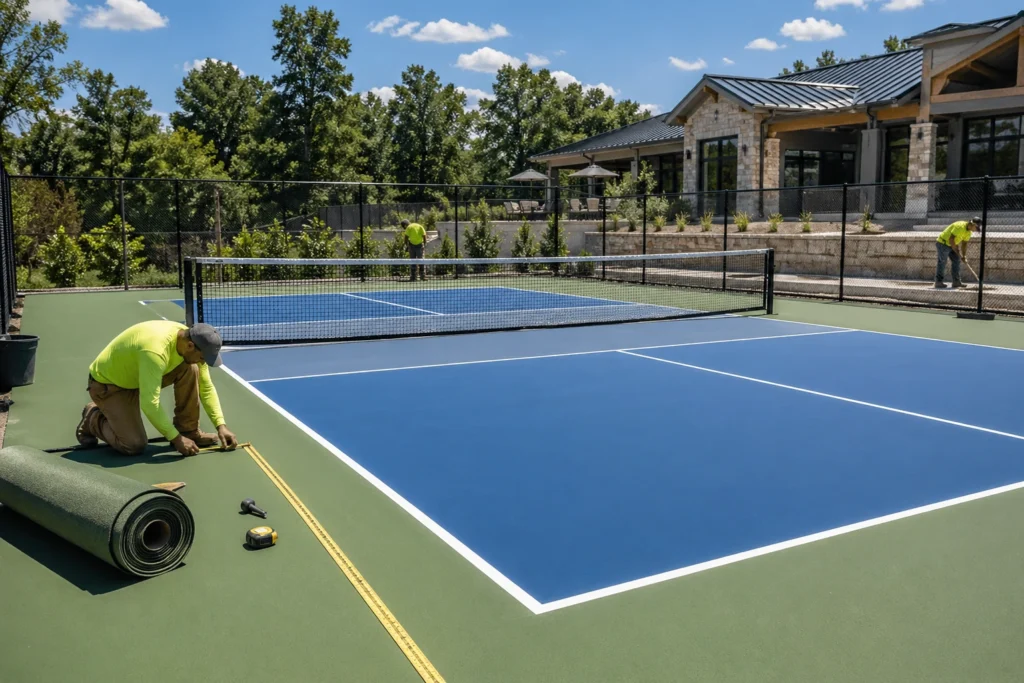
Pickleball court construction is one of the fastest-growing segments in India’s sports infrastructure landscape in 2026. Once considered a niche sport played primarily in the United States, pickleball has made a remarkable entry into India’s fitness ecosystem – sweeping across premium residential societies, corporate campuses, schools, and sports academies in cities from Mumbai and Bengaluru to Indore, Coimbatore, and Lucknow. According to India’s Sports Infrastructure Development Report 2026, the domestic demand for multi-sport courts – including pickleball – has grown by over 38% year-on-year, driven by rising urban health awareness and government-backed sports promotion schemes under the Khelo India programme. Whether you are a housing society chairman planning a multi-sport zone, a sports club upgrading its facilities, or a school expanding its extracurricular offerings, understanding the nuances of professional court construction is critical. At Turf8, we specialise in end-to-end pickleball court construction across India – from site assessment and material sourcing to surface installation, line marking, and post-installation maintenance. This guide walks you through everything you need to know before breaking ground. Why Is Pickleball Court Construction Booming in India in 2026? Pickleball court construction has surged in popularity for a simple reason: the sport itself is exploding. India’s Pickleball Federation reports over 4.2 lakh registered players nationwide as of early 2026 – a 3x jump from 2023 figures. The sport’s low barrier to entry, compact court dimensions (only 6.1 m × 13.4 m), and suitability for all age groups make it ideal for India’s urban spaces where land availability is always at a premium. Several macro trends are accelerating this growth: What Does Professional Pickleball Court Construction Actually Involve? Pickleball court construction is far more than simply painting lines on a flat surface. A professionally built court involves multiple technical layers, each of which affects player safety, ball bounce consistency, drainage efficiency, and long-term durability. Cutting corners at any stage can result in surface cracking, waterlogging, or uneven ball behaviour within just one monsoon season. 1. Site Assessment & Sub-Base Preparation Every pickleball court construction project begins with a thorough site assessment. Turf8’s technical team evaluates soil bearing capacity, existing drainage patterns, slope gradient, and proximity to trees or water bodies before recommending a sub-base design. For most Indian outdoor courts, a compacted crushed stone sub-base of 100–150 mm depth is layered beneath a concrete or asphalt wearing surface. 2. Surface Material Selection Pickleball court construction in India typically uses one of three surface types depending on the location, budget, and usage intensity: 3. Court Markings, Nets & Accessories Pickleball court construction is only complete once regulation line markings have been applied using UV-resistant, non-glare paint or tape. The kitchen line (non-volley zone), baseline, centreline, and sidelines must meet USA Pickleball/IFP specifications – the same standards followed in Indian national tournaments. Net posts, tension cables, and powder-coated frames are installed as the final stage. How Does Turf8 Ensure Premium Quality in Every Pickleball Court Construction Project? Pickleball court construction at Turf8 follows a rigorous, 6-stage quality assurance process developed over years of delivering sports infrastructure across India’s diverse climates – from the coastal humidity of Chennai and Kochi to the dry heat of Rajasthan and the heavy monsoons of Maharashtra and Assam. This systematic approach has earned Turf8 repeat engagements with prominent housing developers, municipal sports authorities, and private clubs – a testament to the trust built through consistent, high-standard delivery. Pickleball Court Construction for Residential vs. Commercial Projects: What’s Different? Pickleball court construction requirements differ meaningfully between residential complexes and high-footfall commercial or institutional environments. Understanding these differences helps clients plan budgets and timelines realistically. Residential Complexes & Gated Communities For housing societies in cities like Pune, Hyderabad, and Gurugram, pickleball court construction is typically a single or dual-court installation within an existing landscaped area. Key priorities are aesthetics (the court should complement the surrounding greenery), low noise impact on residents, and minimal maintenance overhead. Synthetic turf or cushioned acrylic surfaces are preferred here for their softer playability and quieter ball impact. Sports Clubs, Schools & Government Projects Pickleball court construction for sports clubs, schools, and government-funded facilities demands tournament-grade specifications. These projects typically involve 4–8 courts built simultaneously, requiring robust sub-bases, high-intensity acrylic or resin-bound surfaces, permanent fencing systems, and integrated LED lighting meeting minimum 500-lux illumination standards for evening play. Turf8 has executed such multi-court projects under Smart City Mission and district sports authority mandates across Tier 2 cities including Nagpur, Vizag, and Vadodara. How Does Sustainable Pickleball Court Construction Work in India? Pickleball court construction is increasingly being integrated into India’s broader sustainable urban development agenda. Green-rated housing projects, IGBC-certified campuses, and RERA-compliant townships are now specifically requesting eco-conscious sports infrastructure as part of their green building compliance. Turf8’s advanced turf technology incorporates several sustainability-forward practices in its pickleball court construction projects: The Ministry of Youth Affairs and Sports’ National Sports Development Fund has identified sustainable multi-sport infrastructure – including pickleball – as a priority investment category under its 2025–2030 action plan, further validating the long-term growth trajectory for professionally constructed courts across India. How Do You Choose the Right Pickleball Court Construction Company in India? Pickleball court construction is a significant capital investment, and choosing the wrong contractor can result in costly rework within just 12–18 months. Here are the key questions to ask any prospective construction partner before signing a contract: At Turf8, we welcome every one of these questions and are proud to answer them with documented evidence. Our portfolio spans residential complexes, CBSE schools, private sports clubs, and government-awarded municipal projects – giving us the breadth of experience to deliver on every project type, regardless of scale. Conclusion: Is 2026 the Right Time to Invest in Pickleball Court Construction? Pickleball court construction in India has moved well beyond a trend – it is now a tangible, monetisable infrastructure investment. For housing societies, it enhances property value and resident satisfaction. For schools and clubs, it expands revenue streams and community engagement. For government bodies, it supports grassroots sports development in line