
Top 5 Mistakes Clubs Make During Cricket Turf Installation (And How to Avoid Them)
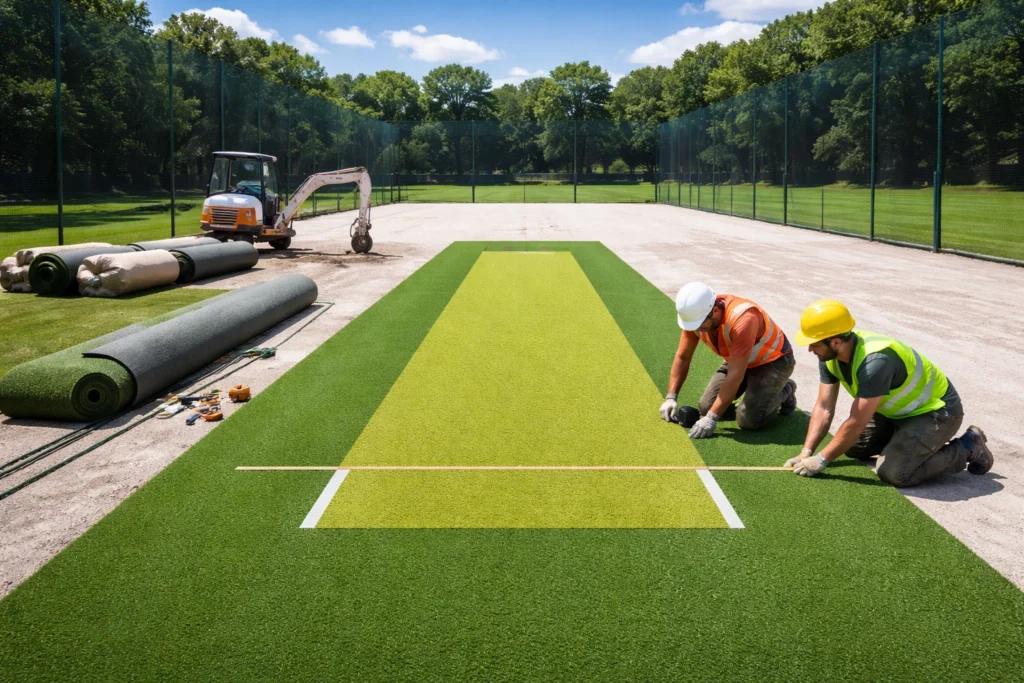
Cricket turf installation is one of the most technically demanding projects in Indian sports infrastructure — and one of the most frequently mishandled. From school grounds in Lucknow to district cricket association facilities in Pune, the same costly errors appear again and again: wrong surface grades, inadequate drainage, undertrained installation crews, and maintenance plans that exist only on paper. India’s synthetic cricket pitch market is expanding at pace. According to a 2025–26 Sports Infrastructure Survey by the Board of Control for Cricket in India (BCCI) development division, demand for synthetic and semi-synthetic cricket surfaces has grown by over 28% in the last two years, with Tier 2 and Tier 3 cities accounting for nearly 40% of new installations. Yet quality complaints have grown alongside demand — largely because too many clubs are making avoidable mistakes at the planning and procurement stage. This guide covers the five most damaging mistakes clubs make during cricket turf installation, with practical guidance on how to get each decision right. If you are planning a new pitch or upgrading an existing ground, start with Turf8’s expert cricket turf installation services — and read this before you sign any contract. Why Is Professional Cricket Turf Installation So Critical in India in 2026? Cricket turf installation in India operates under conditions that punish poor workmanship faster than almost anywhere else in the world. Extreme monsoon rainfall, scorching dry summers, and significant temperature variation between seasons place intense stress on every component of a synthetic cricket surface — the fibre, the infill, the backing, and most critically, the sub-base beneath it. A well-installed synthetic cricket pitch delivers consistent bounce, predictable ball behaviour, and safe playing conditions through 10–12 years of use. A poorly installed pitch begins to show problems within 18–24 months: uneven bounce caused by sub-base settlement, surface blistering from poor drainage, fibre flattening from wrong pile specifications, and joint failures at seam lines. Fixing these problems after installation typically costs 60–80% of the original installation price — without solving the underlying cause. Mistake 1: Choosing the Wrong Turf Grade for the Playing Standard Cricket turf installation decisions too often start and end with price per square metre — without any consideration of the playing standard, user intensity, or regulatory requirements of the facility. This is the most common mistake, and it compounds every other problem that follows. Synthetic cricket surfaces in India come in broadly three performance tiers: Cricket turf installation at the wrong grade creates problems at both ends of the spectrum. Clubs that install a basic-grade surface on a match-standard facility find themselves with inconsistent bounce and excessive wear within two seasons. Clubs that over-specify for a school practice net pay ₹3–5 lakh more than necessary. The right grade depends on a proper needs assessment — not on what a salesperson has in stock. How to Avoid This Mistake Define your playing standard, average daily usage hours, and regulatory requirements before approaching any supplier. If your facility hosts district or state-level matches, confirm the specification required by your state cricket association. Turf8’s 2026 India market insights show that over 35% of client complaints about synthetic cricket surfaces involve surfaces installed at the wrong grade for the actual playing intensity — a problem that is entirely preventable at the planning stage. Mistake 2: Ignoring Sub-Base Engineering Cricket turf installation failures in India are caused by sub-base problems more often than by surface problems. The sub-base — the engineered foundation layer beneath the turf — determines drainage performance, surface stability, bounce consistency, and long-term durability. Yet in the Indian market, sub-base preparation is the cost that unscrupulous vendors most commonly cut to reduce their quoted price. A correct sub-base for a synthetic cricket pitch typically involves: Cricket turf installation on an inadequate sub-base will develop settlement cracking within 1–2 monsoon cycles. Once the sub-base settles unevenly, the surface above it follows — creating dangerous low points where water pools, and high points where the turf lifts from the base. Repairing this after installation means removing and relaying the surface entirely, often at a cost of ₹8–18 lakh for a standard practice area. How to Avoid This Mistake Never accept a quote that does not itemise sub-base preparation as a separate line item with specified materials and depths. Request a site survey report and sub-base design drawing before work begins. If a vendor quotes the same price per square metre regardless of your soil conditions, they are not factoring in proper sub-base engineering. Walk away. Mistake 3: Underestimating Drainage Requirements for Indian Monsoon Conditions Cricket turf installation in India must be designed around one non-negotiable reality: the monsoon. In states like Maharashtra, Kerala, Karnataka, West Bengal, and across the entire Northeast, cricket grounds receive 1,500–3,500mm of annual rainfall concentrated across 3–4 months. A synthetic cricket pitch that cannot clear standing water within 30–45 minutes of heavy rainfall is effectively unusable for a third of the year — which defeats the entire purpose of switching from natural turf. Poor drainage in cricket turf installation manifests in three damaging ways. First, standing water on the surface accelerates UV degradation of the turf fibres and promotes algae and fungal growth. Second, water that penetrates through the backing but cannot escape the sub-base causes saturation, lifting the turf from the base layer. Third, repeated wet-dry cycles cause differential settlement in the sub-base, destroying surface uniformity. According to the India Meteorological Department’s 2025 rainfall intensity data, peak rainfall events in Mumbai, Bengaluru, and Kolkata regularly exceed 80–120mm per hour during peak monsoon. A properly engineered synthetic cricket pitch drainage system must handle a minimum of 150mm per hour to provide a safety margin. How to Avoid This Mistake Specify minimum drainage capacity as a requirement in your brief — not as something to be determined later. Ask your contractor to demonstrate how the perimeter drainage and sub-base together achieve the required drainage rate for your region. In high-rainfall zones, a perforated backing membrane combined with a channel drain system and an