
The Ultimate Pickleball Court Installation Guide for Clubs, Schools & Resorts
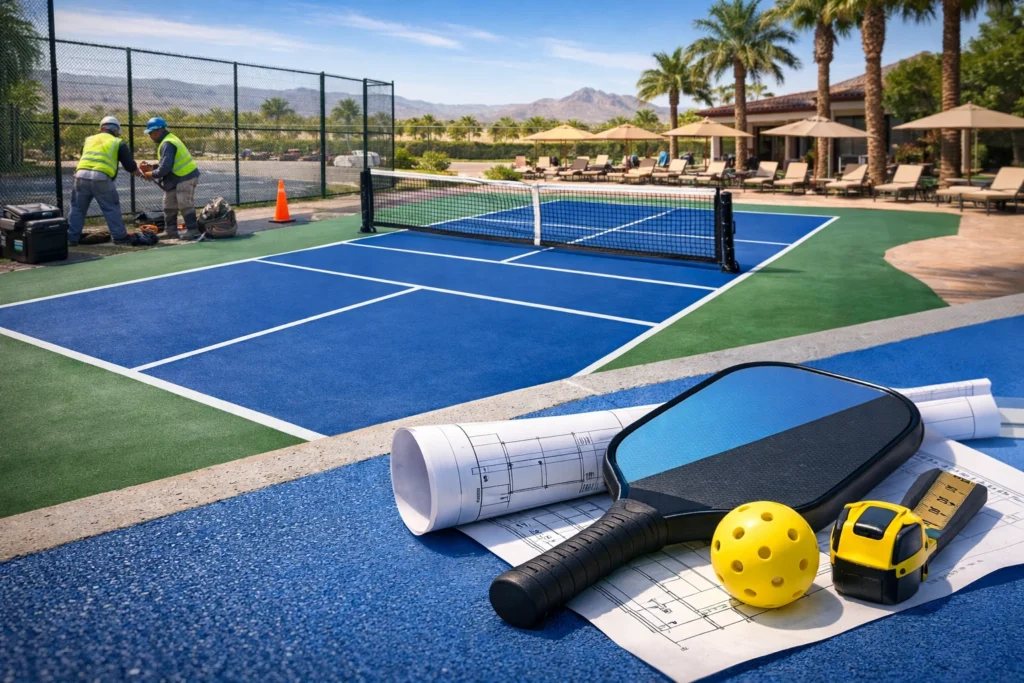
Pickleball court installation is fast becoming one of the most requested sports infrastructure projects across India — and the growth curve shows no signs of slowing. What was considered a niche recreational sport just three years ago is now being installed in residential complexes in Gurugram, luxury resorts in Goa, school sports programmes in Coimbatore, and corporate campuses in Hyderabad. The sport has officially arrived in India, and with it, a new wave of construction demand that the market is only beginning to meet. India’s pickleball player base grew from an estimated 40,000 in 2023 to over 2.5 lakh active players by early 2026, according to the Pickleball Federation of India’s membership and event participation data. The number of registered courts has tripled in the same period, with demand concentrated in metro cities but accelerating sharply in Tier 2 cities like Pune, Jaipur, Chandigarh, and Kochi. Yet despite this boom, a large proportion of new courts are being built without adequate technical guidance — leading to poor surface performance, premature wear, and expensive remediation. This guide covers everything you need to know about pickleball court installation in India in 2026: court dimensions, surface options, lighting, fencing, costs in rupees, and the maintenance commitments that protect your investment for years to come. For expert guidance and a project-specific estimate, explore Turf8’s professional pickleball court installation services — trusted by clubs, schools, and resorts across India. Why Is Pickleball Court Installation Growing So Fast in India in 2026? Pickleball court installation demand in India is being driven by a convergence of factors that are unlikely to reverse. The sport is accessible across age groups — a key differentiator in a country where badminton has traditionally dominated indoor racquet sports. Pickleball requires less court space than tennis, less physical intensity than squash, and can be learned to a playable standard within a single session. For facilities looking to maximise returns from limited space, those attributes are commercially compelling. The amenity value of a pickleball court has become a meaningful differentiator for residential developers and resort operators. According to a 2025–26 JLL India Real Estate Amenities Report, sports courts — particularly pickleball and padel — ranked in the top five amenities influencing premium residential purchase decisions in metro cities. Developers in Mumbai, Delhi NCR, and Bengaluru are now treating pickleball courts with the same seriousness as swimming pools and gymnasiums. Pickleball court installation is also being embraced by schools under the New Education Policy 2020 sports mandate, which requires expanded recreational infrastructure. Smaller footprint, lower construction cost, and shorter installation timeline compared to tennis or basketball make pickleball courts the practical choice for schools working within constrained budgets and site sizes. What Are the Standard Dimensions for a Pickleball Court in India? Pickleball court installation must follow the standard dimensions set by the USA Pickleball Association (USAPA) and adopted by the Pickleball Federation of India for all registered competition and club play. Getting the dimensions right from the start is essential — an undersized court cannot be corrected after construction without full demolition and rebuild. The standard pickleball court dimensions are: Pickleball court installation for multi-court facilities requires careful planning of run-off buffers between adjacent courts. A minimum of 3 metres between parallel courts and 3.6 metres between end lines of adjacent courts is recommended for safe play. For indoor installations — increasingly common in schools and sports clubs — a minimum ceiling height of 6.1 metres is required to accommodate lob shots. How Many Pickleball Courts Fit on a Standard Tennis Court? Pickleball court installation is often done by converting existing tennis courts — a practical approach that is gaining traction across Indian clubs, schools, and residential complexes with underused tennis infrastructure. A standard tennis court of approximately 23.8 metres x 10.9 metres can accommodate four pickleball courts, either as permanent installations or using temporary portable net systems for flexible use. This conversion approach significantly reduces sub-base costs since the existing surface and base are already in place. What Surface Options Are Available for Pickleball Court Installation in India? Pickleball court installation surfaces determine everything from ball bounce characteristics and player comfort to long-term maintenance requirements and total cost of ownership. India’s market in 2026 offers four principal surface categories, each appropriate for different facility types and budgets. 1. Acrylic Hard Court Surface Pickleball court installation using acrylic hard court surfaces is the most widely adopted approach in India in 2026 and the default choice for club, resort, and residential facilities seeking long-term durability and authentic game performance. Applied over a concrete or asphalt sub-base in multiple layers, acrylic surfaces provide a cushioned, non-slip playing texture that performs consistently across India’s varied climate conditions. 2. Cushioned Acrylic System Pickleball court installation with a cushioned acrylic system adds a rubberised base layer beneath the standard acrylic coat, reducing joint impact and fatigue for older players and high-frequency recreational users. This is the preferred specification for resort facilities, senior fitness programmes, and corporate wellness courts where player comfort is a primary consideration. 3. Modular Polypropylene Court Tiles Pickleball court installation using interlocking polypropylene tiles offers the fastest installation timeline and greatest flexibility for facilities that need to convert spaces between multiple uses. Tiles can be installed over any firm, level surface — including existing concrete, asphalt, or even indoor wooden floors — and removed without damage to the underlying surface. 4. Synthetic Turf Surface Pickleball court installation on synthetic turf is a growing preference for outdoor recreational facilities, residential complexes, and resorts where aesthetic integration with landscaped surroundings is a priority. Short-pile artificial turf at 10–15mm pile height, with silica sand infill for stability, provides a comfortable playing surface with good ball response for recreational play. Turf8’s advanced turf technology ensures that all synthetic turf pickleball surfaces are installed with UV-stabilised fibres, appropriate sand infill density, and a perforated backing that delivers drainage rates compatible with Indian monsoon conditions — a specification detail that generic suppliers routinely overlook. What Sub-Base Is Required for an